By Xia He, Zhijian Liang, Haiyu Wu, and Tien Ming Lee
This Plain Language Summary is published in advance of the paper discussed. Please check back soon for a link to the full paper.
Fear is a common tool in campaigns that ask people to protect nature—for example, messages about endangered species or habitat loss. But not all fear-based messages work equally well, and researchers wanted to find out how to make them more effective.
In this study, over 1,400 people took part in an experiment using real-style public service ads about wildlife conservation. The researchers tested two main things: first, whether the threat was framed as harmful to people or to wildlife, and second, whether the ad gave people practical advice on what to do (like a simple slogan or a concrete action plan) or no advice at all.
The results showed that giving people clear guidance is essential. Ads that only scared people without offering a solution were the least effective.
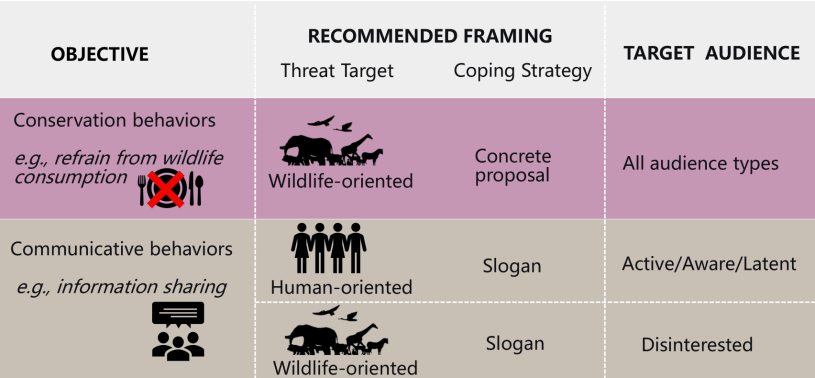
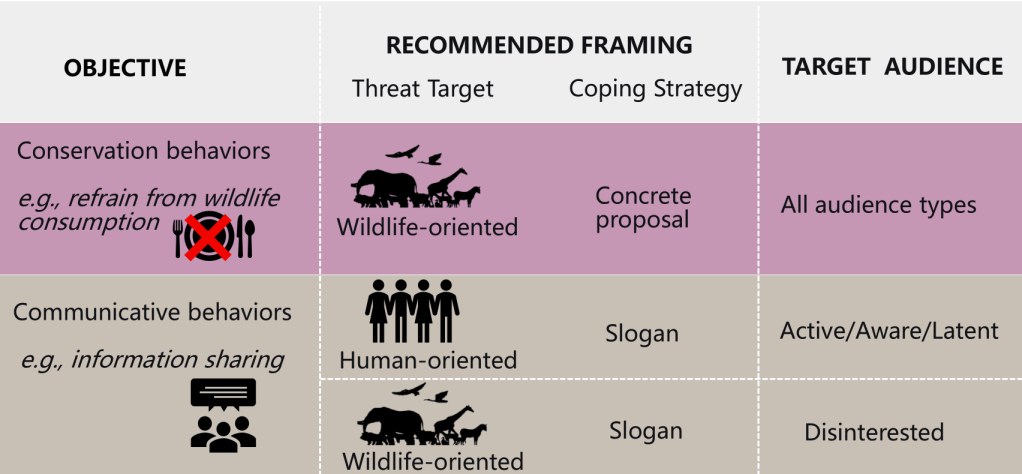
The best way to encourage people to take actual conservation action—like changing their daily habits—was to use a wildlife-focused message (emphasizing that nature matters for its own sake) and pair it with a specific, doable suggestion. However, if the goal was to get people to share the message with others (for example, on social media), a human-focused frame (emphasizing how nature benefits people) combined with a catchy slogan worked better.
Interestingly, one group—“disinterested” audiences who weren’t already engaged in conservation—responded more positively to wildlife-focused fear messages than to human-focused ones.
For conservation communicators and campaign designers, the study offers three practical tips: always include solutions with fear-based messages; match your framing to your main goal (action vs. sharing); and consider tailoring your threat framing to different audience groups to boost overall impact. These strategies can help make conservation campaigns more powerful and efficient in inspiring people to protect biodiversity.

