By Julia Martinez-Pardo, Jamie Burton, Marie Pratzer, Matthias Baumann, Alfredo Romero-Muñoz, Verónica A. Quiroga, Ricardo Torres, Viviana Rojas Bonzi, Daniela Tamburini, Matias Mastrangelo, Oswaldo Maillard, Cecilia Trillo, Thiago Costa, Yamil E. Di Blanco, Frederick Bauer, Melina Faingerch, Emilia Sago Herrador, Julieta Decarre, Andrea Neme, Hugo Del Castillo, Jessica Manzano-García, Micaela Camino, A. Sofía Nanni, and Tobias Kuemmerle
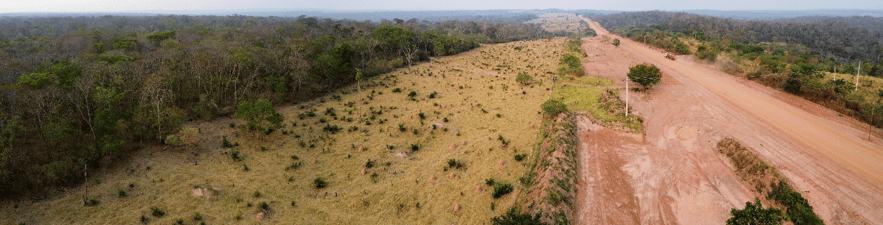
Photo: Alfredo Romero-Muñoz – HU Berlín
This Plain Language Summary is published in advance of the paper discussed. Please check back soon for a link to the full paper.
Hunting is an important part of how many people around the world live and interact with wildlife; however, it can put wildlife at risk. But hunting doesn’t mean the same thing everywhere. People may hunt to feed their families, for recreation, to earn money, or to protect their livestock. They may also use different methods and hunt in different places. Treating all these situations simply as “hunting” can hide important information about which animals and places are most affected, and what conservation action may be needed.
In this study, we developed a way to show this variety of hunting on maps. We focused on the Dry Chaco and Chiquitano, two large regions of tropical dry forests and savannas in South America, where the landscape has changed substantially as forests have been replaced by farming, cattle raising and other human activities. We looked at published studies about hunting in the region, and then asked local experts to help us identify the main ways in which people hunt. We identified four broad types of hunting: traditional, retaliatory, commercial, and recreational. We then used information about how land is used to estimate where each type of hunting is more likely to occur. We also compared these maps between 1985 and 2023 to see how hunting changed as the landscape changed.
We found that these hunting types are not separate: more than one can occur in the same area, and the same person can hunt for more than one reason. We also found that hunting changed as land use changed. Our approach makes this diversity visible across large areas and could be adapted to other tropical dry forests and savannas. By showing where and why people hunt, we hope to help policy-makers better understand relationships between people and wildlife and develop actions that fit the places and people involved.

