By Juan Sebastián Felipe Olmos-Núñez, Cristina Adams, Vitor Hirata Sanches, and Fernando Fagundes Ferreira.
This Plain Language Summary is published in advance of the paper discussed. Please check back soon for a link to the full paper.
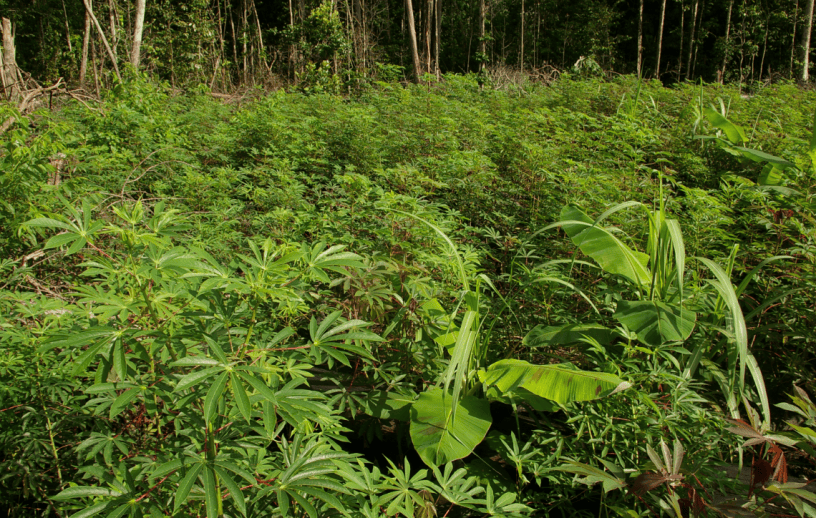
Many Indigenous peoples in South America, and specifically in the Amazon, have cultivated manioc for thousands of years. Over time, they have developed and maintained hundreds of different varieties of this important crop. Researchers have suggested that kinship rules, like marriage practices and residence rules, along with the transmission of varieties from mother to daughter play an important role in preserving this diversity. However, it has been difficult to test how these processes work over long periods of time.
In our study, we used computer simulations to explore how these rules influence the movement of manioc varieties across generations. We created virtual communities in which people marry, move to another place and pass on plants according to different cultural rules. We then followed the diversity of manioc varieties through time. Our objective was to understand how these mechanisms affect diversity.
One of our results is that these cultural practices can maintain crop diversity even when communities are isolated, although not completely. We also found that the combination of marriage patterns and the way planting material is inherited can create or maintain important differences between families and communities. As registered in various indigenous communities, in our model some mechanisms led to conditions where varieties become widely shared; other processes, on the contrary, had them concentrated in particular family lineages.
An important interpretation of our results is that cultural traditions are not simply associated with biological diversity: they can actively shape and preserve it. We suggest one way it is done. Understanding these relationships can help explain why some communities maintain remarkable crop similarity and why certain plants, together with the knowledge needed to cultivate them, may be found only within specific families. More broadly, our work stresses the importance of Indigenous knowledge and social organization in sustaining biodiversity.

