By Ligtermoet E., Leith P., Bradby K., Bourne M., Gaynor A, Gutierrez V., Horwitz P., Knight A., and Underwood J.
This Plain Language Summary is published in advance of the paper discussed. Please check back soon for a link to the full paper.
Hope and inspiration may be essential to countering the psychosocial impacts of living through the polycrisis. This is because they can catalyse durable, collective action needed for transformational change.
The polycrisis comprises interconnected crises (climate, water, biodiversity, disease, poverty) affecting populations unevenly. Coordinating effective and just responses is a tremendous governance challenge. Many scholars have suggested governance that supports diverse groups to work together and advance shared outcomes. They often proffer processes, or principles, capabilities needed and more. These are well and good but miss vital ingredients.
Hope and inspiration play under-explored roles. We unpack these ingredients, their potential roles in polycentric governance, and suggest further exploration through research-policy-practice inquiry and experimentation.
After reviewing how hope and inspiration are understood across psychology, social science and environmental governance, we explore land degradation as a tangible exemplar of the challenges of polycrises. This exemplar has a clear counterpoint — landscape restoration. Here, hope and inspiration are integral to the creation of complex, aligned outcomes.
Hope and inspiration are motivational processes common to all humans yet shaped by individual and social context. Hope acts as a motivating and binding agent that links individuals with achievable, meaningful goals, and groups together in pursuit of them. Inspiration plays a role, not only in shaping individual behaviour and well-being, but socially through its contagion effect, travelling via relationships, networks, and agents of transmission (i.e. intermediaries) to catalyse inspired-action pathways, enhance innovation, and strengthen adaptive capacity in times of rapid change. In governance, hope and inspiration can play distinct roles in forging social alliances, activating social networks, strengthening and sustaining cohesion.
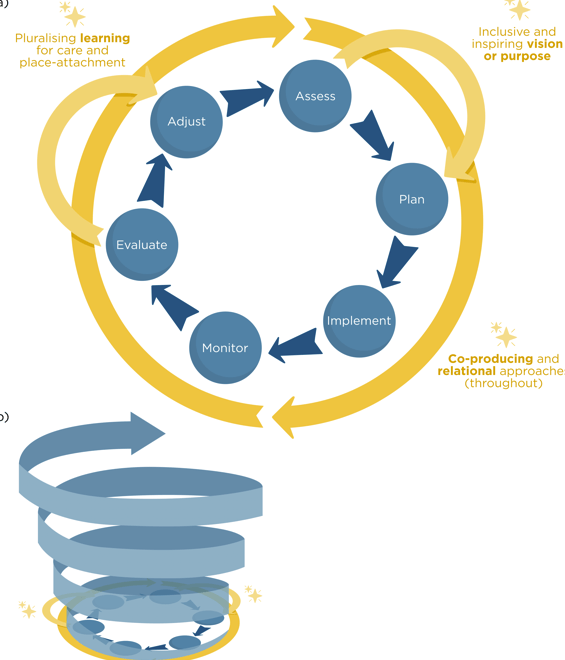
We offer three practical ways that hope and inspiration can be entrained in adaptive management governance practices, though 1) building an inclusive, ambitious but achievable vision; 2) co-creation throughout decision-making cycles; and 3) through inclusive learning opportunities that foster care and place-attachment.
A policy-research-practice agenda that takes hope and inspiration seriously as means of catalysing and sustaining collective action can take big strides in addressing the polycrisis. This work is relevant for diverse, large-scale sustainability transitions urgently required, including across energy and agriculture.

