By Valerie Berseth, Sugeet Miglani, Tom Chance, Adrian Spidle, and Hannah Harrison
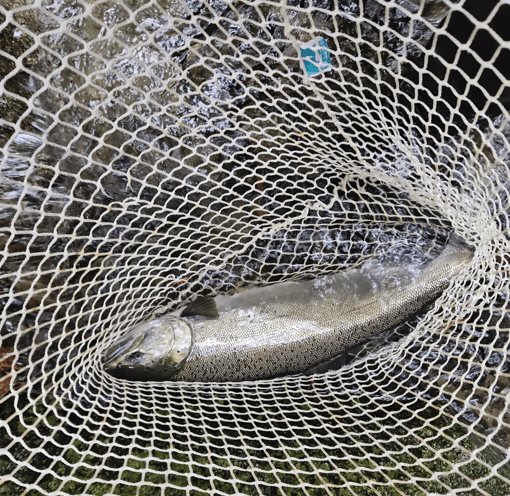
Photo Credit: Valerie Berseth
This Plain Language Summary is published in advance of the paper discussed. Please check back soon for a link to the full paper.
Salmon populations have declined across North America, leading to a long-standing debate regarding the role of human-assisted reproduction programs, such as hatcheries. Much of the scientific and public conversation centers on whether these facilities negatively impact wild salmon through genetic changes or competition for habitat. Consequently, there is often pressure to reduce or eliminate hatchery operations.
In this study, we aimed to understand how Indigenous communities articulate the role of hatcheries within their broader relationships with salmon, as these perspectives have been largely absent from the existing scholarly literature. Our team of settler researchers and practitioners working for Indigenous governments and organizations analyzed 172 public-facing materials shared on the websites of 36 Indigenous governments and organizations in Canada and the United States that are involved in hatchery programs.
Across these sources, we identified recurring narrative themes. Many sources described hatcheries as a direct response to the widespread loss of productive salmon habitat caused by industrial development and climate change. For many sources we reviewed, the primary goal of hatchery involvement is not to simply increase production, but to uphold inherent and Treaty rights and obligations to salmon, maintain food security, and ensure the continuation of cultural practices. In this way, hatcheries serve as a vital, adaptive bridge to sustain human-salmon relationships until long-term habitat rehabilitation can be fully realized.
Our findings suggest that current hatchery debates are often too narrow by focusing primarily on biophysical risks, overlooking how Indigenous Nations and organizations engage in human-assisted reproduction. We emphasize the importance of understanding Indigenous perspectives and Indigenous-led approaches to hatcheries to support the long-term resilience of both salmon and the communities that steward them.

