By Pedro Galvão-Ferreira, Marta Ferreira, Teresa Paulino, Beste Soybilge, Nuno Nunes, and Valentina Nisi
This Plain Language Summary is published in advance of the paper discussed. Please check back soon for a link to the full paper.
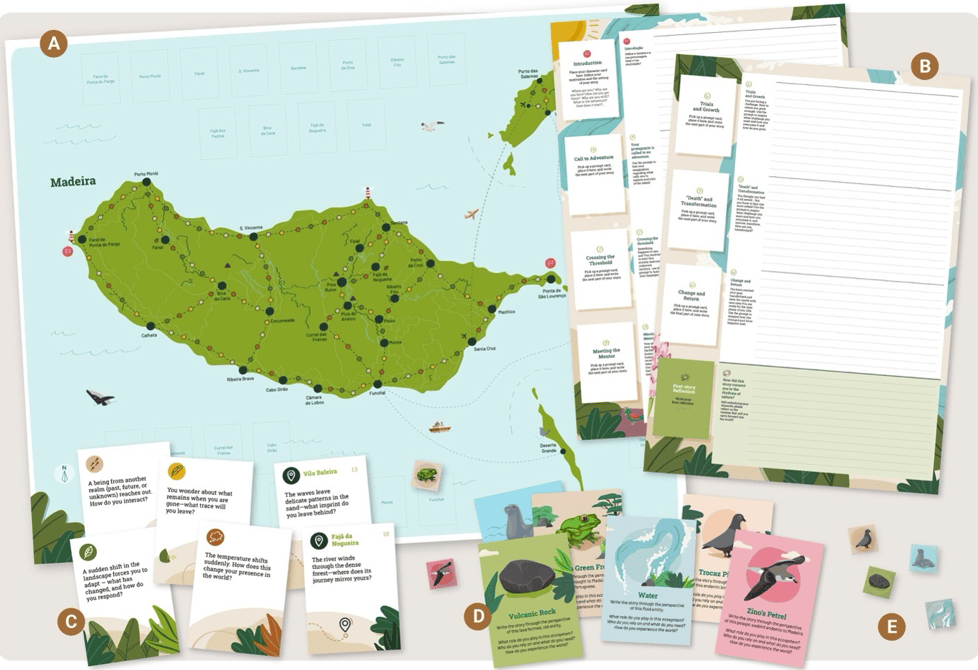
Imagine passing an afternoon writing a story — not as yourself, but as a Trocaz pigeon navigating Madeira’s forests, or as a piece of volcanic rock slowly shaped by the sea. That’s exactly what players do in Rock, Paper, Pigeon (RoPPi), a board game we designed to challenge the way people think about nature, wildlife, and heritage.
Most heritage games tell stories from a human point of view. We, however, wanted to ask: what happens when players are asked to see the world through entirely different eyes? The game is set in the rich and unique ecosystems of Madeira Island. Each player takes on the role of one of its nonhuman inhabitants — a monk seal, a petrel, a frog, water, or rock — and writes a short adventure story guided by prompts drawn from the island’s history, folklore, and landscapes.
We ran the game with two groups: biologists and researchers who design interactive technologies. Both groups played the game and filled in questionnaires before and after, and we analysed the stories they created.
The results were striking. Biologists wrote stories mostly grounded in ecological reality, focused on survival, predation, seasons, and the tangible consequences of human activity. The designers and technologists tended toward more imaginative, emotionally rich stories exploring transformation, community, and the beauty of interspecies connection. Both groups reported that inhabiting a nonhuman character shifted how they perceived landscapes and other species.
Across both groups, the game fostered empathy for nonhuman lives and prompted reflection on humanity’s role in shared environments — something that textbooks and lectures rarely achieve quite so directly.
Games like RoPPi are inexpensive, require no technology, and can be played in schools, museums, or nature reserves. Our findings suggest that this kind of playful, story-based approach holds real promise for environmental education, conservation outreach, and rethinking how heritage can include the many nonhuman lives that shape the places we love.

