By Diana S. Macias, Thomas Gustie, Paul B. Burow, Brian Adkins, Ana Bacoch, Alexander B. Basaraba, Jacqueline C. Beidl, Benjamin Fillmore, Hunter Fillmore, Elise Holston, Rhiana Jones, Sally Manning, Marc Meyer, Samantha Meyering, Wilfred Nabahe, Emma Sage, Heather Stone, Yarrow Syskine, Alexandra Urza, Allison Weber, Noah Williams, Gabrielle Wong-Parodi, and Miranda D. Redmond
What does it mean to care for a landscape that is under threat? Care includes noticing early signs of stress, returning to familiar places, anticipating future needs, and asking what trees, communities, and institutions need to keep going. In California’s Eastern Sierra Nevada, care is needed for pinyon–juniper woodland ecosystems that drought, pests, wildfire, and climate change increasingly stress. These woodlands are also cultural landscapes where Tribal communities have cared for pinyon trees since time immemorial through pine nut gathering, prayer, and everyday attention to the land.
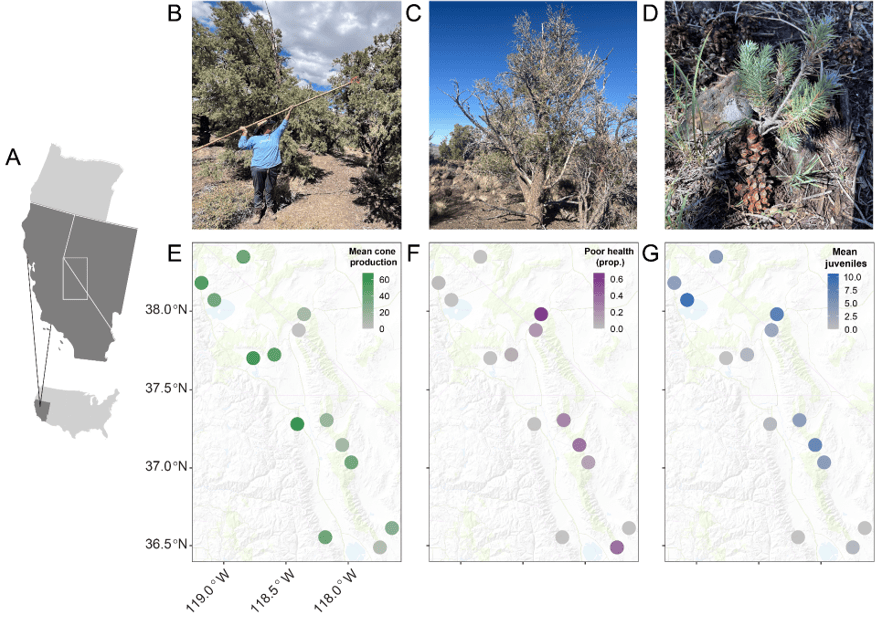
Working in collaboration with environmental departments from the Bishop Paiute Tribe, Big Pine Paiute Tribe, and Washoe Tribe of Nevada and California, we assessed 516 trees, recording their health and counting their cones. We performed this monitoring alongside cultural practices, which Tribal community members created and led. These cultural activities included pine nut gathering and workshops focused on traditional ways of harvesting, cooking, and eating pine nuts.
The monitoring showed big spatial differences in woodland condition. Some areas had high cone production and mostly healthy trees, while others showed signs of stress, such as a scarcity of cones and seedlings. Several stressed areas matched places our Tribal collaborators had already identified through years of observation. Monitoring also documented new areas of concern.
We also asked how the broader public relates to pinyon–juniper woodlands. In a regional household survey of 732 residents, most people recognized pinyon–juniper woodlands from a photograph. Recognition by itself did not strongly predict care. Still, among people who reported lower climate-change knowledge, recognizing pinyon–juniper woodlands linked to higher environmental responsibility. This suggests that familiar landscapes may be one way people come to feel responsible for a place, especially when they do not arrive there through climate awareness alone.
Our findings show that care can be an active guide for stewardship. Care begins with noticing change, but it continues through repeated presence, public responsibility, and institutions willing to support Tribal-led care over time.

