By Elena Friedman, Lauren Redmore, Lora Perkins, and Jennifer Zavaleta Cheek
Scroll to the bottom for the video
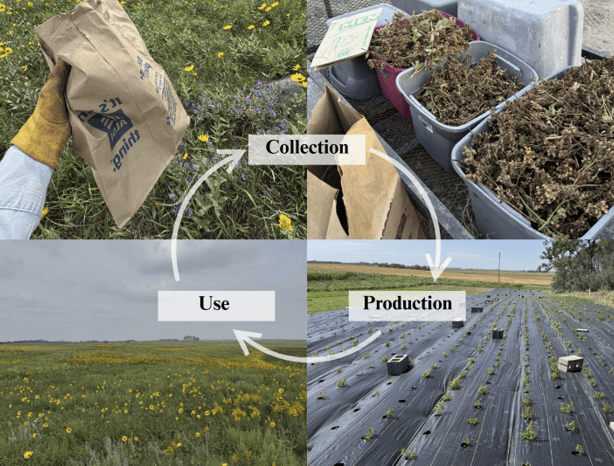
Native seeds are collected from locally adapted plants and are used to restore damaged ecosystems. People who collect, grow, sell, share and plant them do so through networks called native seed systems. When native seed systems are resilient, they can support restoration despite policy changes, funding shifts, and environmental disturbances. Yet there is little guidance on how to develop resilient native seed systems from a social-ecological perspective.
In the United States Northern Great Plains, we conducted observations at 10 sites and spoke with 60 people across the private sector, government, non-profit organizations, and higher education. We identified a variety of people working across commercial and Tribal native seed systems, including collectors, producers, and users. In the commercial system, seed collection was labour-intensive and built on trial-and-error learning, and production was vulnerable to market and environmental conditions and limited funding. In the Tribal system, participants sought to enhance restoration and food and medicinal sovereignty, and challenges included limited funding and land access. Across systems, participants described public disconnection from native landscapes and cultural norms that viewed them as “unproductive,” both of which were thought to hamper resilience.
To enhance resilience, we identified three key people-centred approaches:
- Commercial and Tribal native seed systems benefited from their independence but could be strengthened through respectful collaboration.
- Infrastructure is both social and physical. Buildings and machines are important, but so are the people who adapt equipment and practices to different species, conditions, and restoration goals.
- Institutions and cultural practices can guide long-term coordinated restoration efforts that balance seed collection with conservation.
Our study emphasizes that resilience could be enhanced when people care about, feel connected to, and share an understanding of why native plants and landscapes matter. For people already involved in native seed work, peer learning and mentorship could help sustain participation. For people outside the system, hands-on learning experiences could enhance how they understand and value native landscapes, potentially motivating environmental stewardship. By strengthening these cultural foundations, native seed systems may become more resilient through broader public and political support beyond the UN Decade on Ecosystem Restoration.

