By Katie Moon
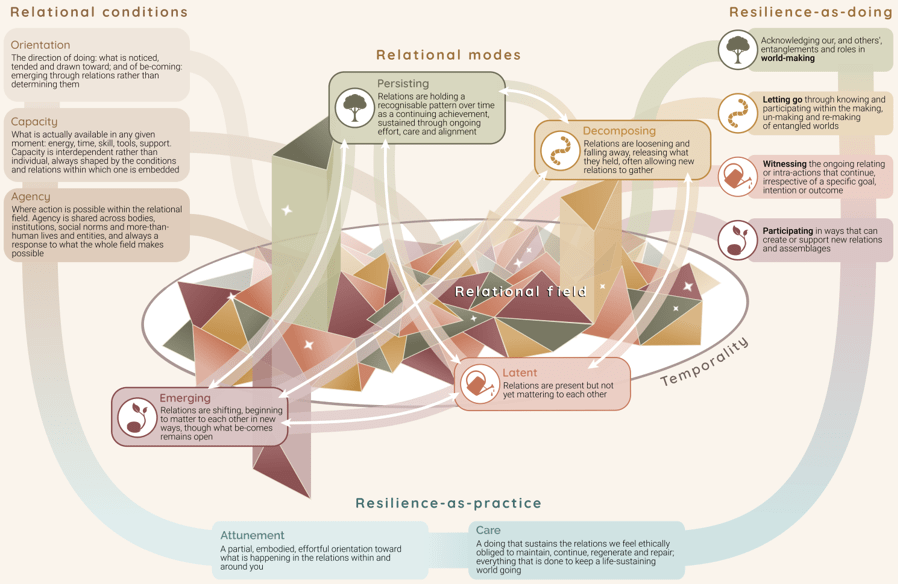
How does a householder become more resilient to climate change? In circling this question, I started paying attention to the systems within which I am embedded, noticing resilience is most typically a judgement of whether what emerges aligns with what we hope for or value. In other words, resilience, as the capacity of a system to absorb disturbance and retain its basic structure and function, seems to capture forms of persistence we approve of, rather than the vitality of relations as they exist.
For example, if a vegetable bed flourishes with species the gardener didn’t plant, that is, ‘weeds’, is that resilience? If those species are edible, does that change things? What if they support native wildlife, and thus biodiversity? This kind of thinking moved me from considering resilience as the properties of entities to the presence and movements of entanglements of relations.
This work offers a conceptual model for understanding resilience as a practice, through four contributions. First, it reconceptualises the relational field as the ground of resilience practice. Second, it positions attunement, the partial, embodied, effortful orientation toward what is happening in the relations around and through you, as central to participation. Third, it identifies four modes through which people encounter relations and assemblages: latent, emerging, persisting and decomposing. And, fourth, it names three conditions through which the nature of participation is enacted: orientation, capacity and agency. Combined, these elements enable a practice that cultivates care and offers a way of understanding how resilience can be lived as practice.


Interesting perspective, thanks
LikeLike