By Kelly Hitchcock, Andrew Moss, Richard W. Yarnell, Gregory Counsell, Leah J. Williams, Kat Hamill, & Simon Tollington
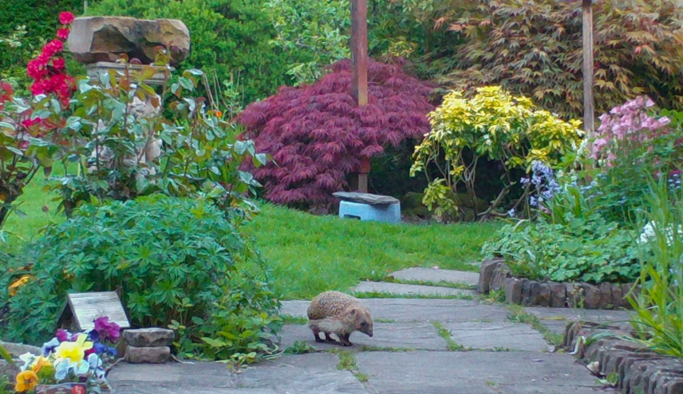
Image credit: Camera trap image collected through Chester Zoo’s Hedgehog Watch project.
Residential gardens comprise a large proportion of urban landscapes and have the potential to support biodiversity by providing important resources for wildlife such as food and shelter. Collectively, they could make a substantial contribution to conserving biodiversity in urban areas. However, achieving this relies on widespread engagement from householders to improve their gardens for wildlife.
Although many conservation organisations encourage the adoption of wildlife-friendly gardening practices, the perceived feasibility and constraints to making such changes experienced by householders remains poorly understood. To explore this, we surveyed 231 households across Great Britain about their willingness to add ten different wildlife-friendly garden features and used a behaviour change framework to identify the barriers that may limit engagement.
We found that, although most gardens already contained some wildlife-friendly features, many respondents were unlikely to make further improvements. Wildflower patches were the only features that people were willing to add, while ponds and compost heaps were the least popular options. The most common barriers were related to practicality, including limited space, the time and effort required, costs, and a lack of knowledge about certain features. Younger respondents and those living in more deprived areas tended to report more barriers than others.
Our findings indicate that relying on encouraging the public to improve gardens for wildlife is unlikely to achieve large-scale positive outcomes for biodiversity. Many people face multiple constraints that limit their ability to make positive changes. This highlights the need for wildlife-friendly features that are affordable, low maintenance, and space-efficient. More broadly, conservation organisations may achieve greater impact by supporting policy0led approaches, such as requiring wildlife-friendly features such as bird nest bricks or hedgehog highways in new housing developments. Such measures could help overcome barriers experienced by individual householders and enhance the contribution of urban gardens to biodiversity conservation.

