By Aman Deep Rathi, Keshab Gogoi, Rajiv Bhartari, and Yadvendradev V. Jhala
In areas where local people experience a large number of large carnivore attacks, for example, from leopards and tigers, it becomes extremely difficult for people to live alongside the carnivores. Information on where, why, and on whom such attacks occur is useful for forming policy and planning strategies to prevent attacks on people.
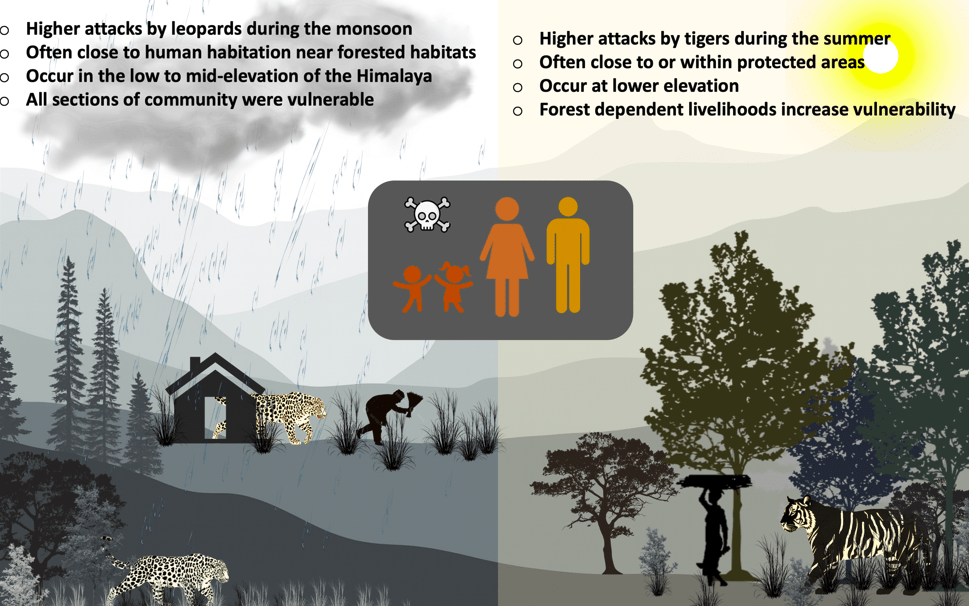
We use in government records from across the Western Himalayan state of Uttarakhand, India, on 132 tiger and 1,914 leopard attacks that occurred between 2000 to 2019 to obtain details on where attacks occur, why they occur, and the victims of the attacks. Using the geographic location of attacks and site-specific information on ecological and geographic variables, we develop predictive models to identify attack hotspots. There were, on average, 98 leopard and seven tiger attacks per year. The victim died in 22.3% of leopard and 34.8% of tiger attacks. Attacks by both carnivores increased over the years. As the tiger population grew, tiger attacks increased. For each 10 new tigers in the population there was about 1 additional attack. Tiger attacks were limited to forested habitats and occurred in higher numbers in seasons when people entered forests for livelihood needs. While leopard attacks occurred across the landscape but peaked during the monsoon when fields were covered with crops that offered the leopards cover.
It is necessary to make site specific investments to reduce attacks. Focusing on conflict hotspots, these investments can involve change in lifestyles, alternative livelihoods that are not forest dependent, proper housing, toilets, tap water, and electricity. Each of these investments can reduce poverty and assist in reducing conflict with large carnivores. Other mitigation measures are smart practices of vigilance, removal of individual problem animals expediently, and judicious use of carnivore proof fencing. Only with such science-informed policy and site-specific management will people tolerate large carnivores and allow large carnivore populations to recover in the Anthropocene.

