By Meryem Aakairi, Sara Elgadi, Hamza Zine, Christel Vidaller, Mohamed Cherkaoui, Emmanuel Corcket, and Irene Teixidor-Toneu
What was the inspiration for this article?
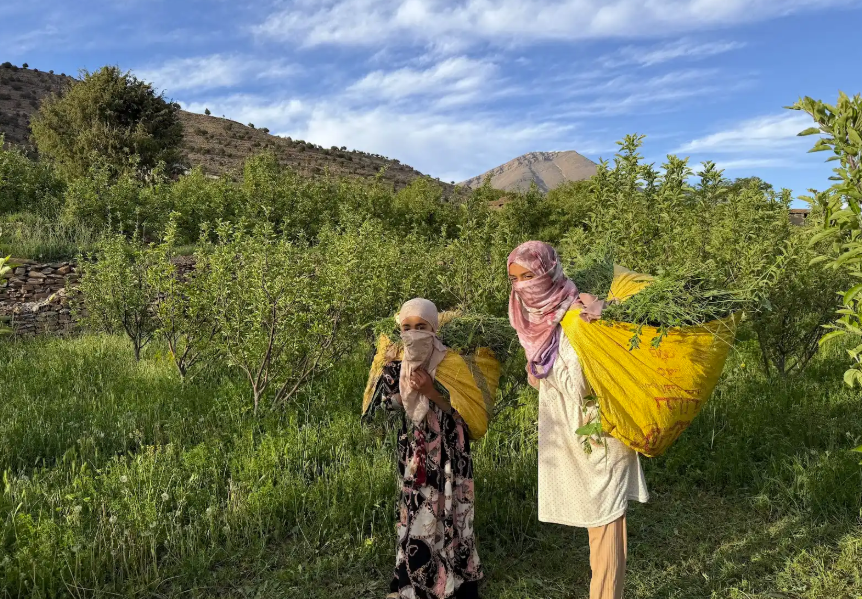
This article was inspired by the women of Ait Bouguemez Valley in the Moroccan High Atlas. During fieldwork, we repeatedly observed that women described the landscape not simply as a collection of natural resources, but as a living network of relationships involving people, animals, plants, water, and cultural traditions. Many conservation studies focus on ecological processes or formal management institutions, yet the daily contributions of women often remain overlooked.
As we listened to women describe grazing areas, forests, irrigation systems, springs, and agricultural fields, it became clear that these places were understood through stewardship practices, responsibilities, memories, and cultural values. This inspired us to explore how women classify and manage their landscapes and how these relationships contribute to both biodiversity conservation and community well-being.
How does your article inform future research?
Our findings highlight the importance of integrating local knowledge, gender perspectives, and relational approaches into environmental research and conservation practice. The concept of ethno-habitats identified by women demonstrates that landscapes are not only ecological units but also social and cultural spaces shaped through long-term interactions between people and nature.
Future research could further investigate how stewardship practices contribute to ecological resilience, how local governance institutions support sustainable resource management, and how environmental and social changes affect these relationships. We also hope that this work encourages greater recognition of women’s knowledge and contributions within conservation and sustainability policies.
Why did you choose People and Nature for your research?
We chose People and Nature because the journal provides an ideal platform for interdisciplinary research that explores the relationships between people and the natural world. Our study combines ethnobiology, ecology, conservation, and sustainability science, and we felt that the journal’s focus on reciprocal human–nature relationships aligned closely with the questions we sought to address.
People and Nature also encourages dialogue between different knowledge systems and values diverse perspectives on environmental stewardship. We believe this makes it an excellent venue for sharing the experiences and knowledge of Amazigh women whose voices are often underrepresented in environmental research.
Read the full published paper – Reciprocal relations shape cultural landscapes: Women’s environmental stewardship in Ait Bouguemez (High Atlas, Morocco)
Read the Plain Language Summary of the published paper
 Relational Thinking