By Daniel G. Pilgreen & Gerard T. Kyle
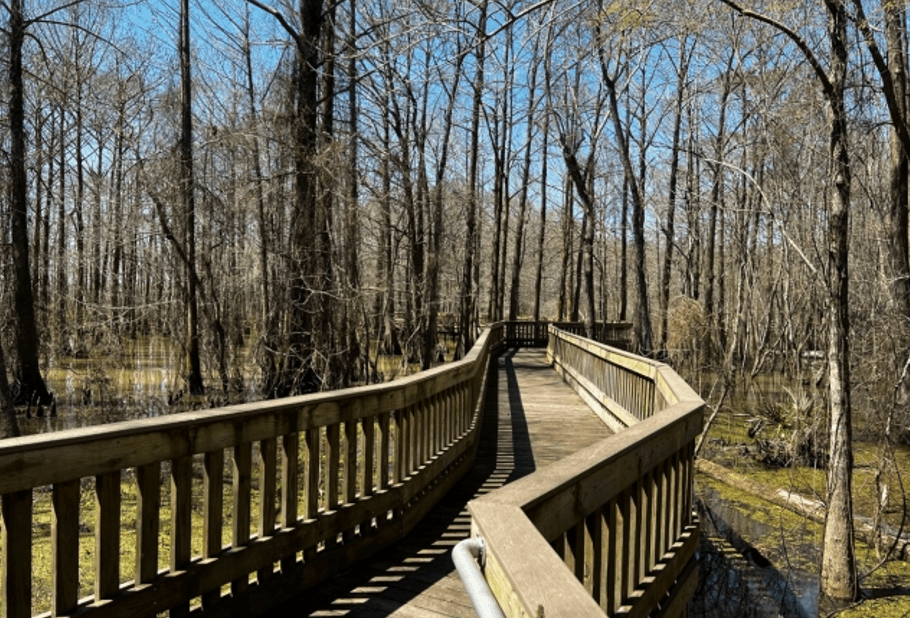
Caption: The Cypress Trail boardwalk through seasonally flooded wetlands at Jocelyn Nungaray National Wildlife Refuge on the Texas Gulf Coast. These opportunities to experience nature may foster the sense of nature connectedness that this study links to stronger climate beliefs and community resilience across political lines.
Coastal communities face growing risks from climate change, including stronger storms, rising sea levels, and the loss of important natural habitats. At the same time, people vary widely in what they believe about climate change, often in ways that reflect political ideology. This study explored whether people’s personal connection to nature might help bridge those ideological divides and strengthen community resilience.
We surveyed 1,045 adult residents across 21 coastal counties in Texas, United States. The survey measured how connected people feel to nature, their beliefs about climate change, their communities’ resilience, and their political orientation. Overall, we found that people who feel more connected to nature are also more likely to believe climate change is real, important, and addressable. They also tend to view their communities as better prepared to adapt to future climate‑related hazards. These patterns held across different political groups.
Political ideology did matter, however. Liberals generally reported stronger climate beliefs than conservatives, but the influence of nature connectedness was strong for everyone. Surprisingly, the positive effect of nature connectedness on key climate beliefs was strongest among conservatives, even though conservatives, on average, reported lower concern about climate change. This suggests that experiences with nature may offer a particularly powerful way to engage individuals who might otherwise be skeptical of climate science. In contrast, the effect of nature connectedness on perceived community resilience did not differ much by political group.
The findings highlight a promising pathway for fostering shared understanding of climate issues in politically divided settings. Rather than relying solely on information campaigns, initiatives that help people spend time in nature, such as nature‑based solutions like parks, wetlands, and green infrastructure, may strengthen climate‑related beliefs and support for community resilience across the political spectrum.
Although the study was focused on the context of the Texas Gulf Coast, the results add to growing evidence that connecting people to nature can encourage concern for environmental change and motivate collective action. Future research should examine whether enhancing nature connectedness directly leads to measurable adaptation or mitigation behaviors.

