By Katrina Marsden, Hanna Petterson, Tasos Hovardas, Angela Lomba, Tobias Plieninger, Valeria Salvatori, Camilla Sandström, and Juliette Young
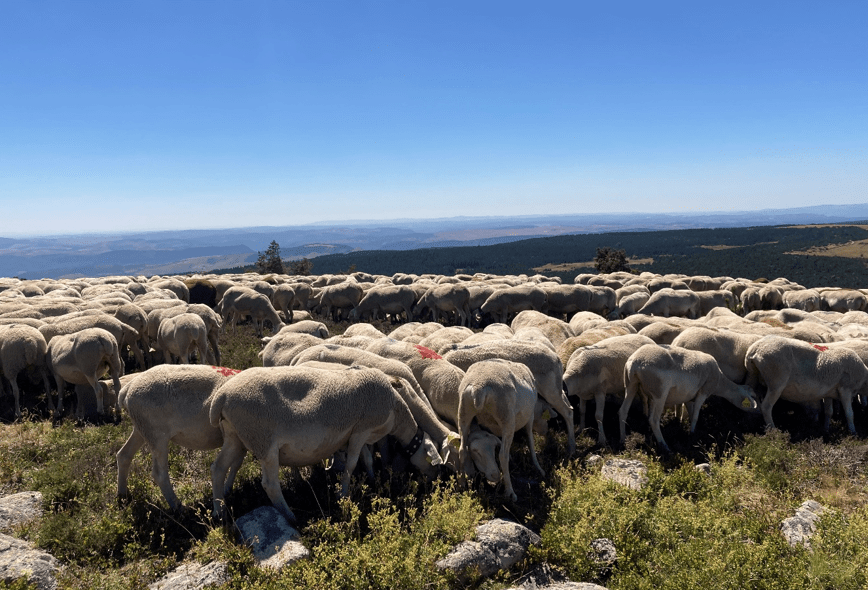
Across Europe, traditional forms of livestock farming are under serious pressure. This paper asks how pastoralists and large carnivores can share the same landscapes, and what policy needs to change to make that possible.
Herders and pastoralists provide enormous benefits: they protect biodiversity, prevent wildfires, store carbon, and sustain cultural heritage. Yet these farming systems are being squeezed from all sides.
In this Special Feature, researchers from Europe, the Americas, and Central and East Asia come together to examine one particularly pressing challenge: the return of large carnivores. Wolves, bears, lynx, wolverines, and other predators have made a remarkable comeback thanks to decades of conservation policy. This is good news for nature, but it creates a problem for pastoralists, whose free-roaming animals are especially vulnerable to attack.
What we found is that carnivore predation cannot be treated in isolation. Pastoralists are already struggling with shrinking grazing areas, rural depopulation, poor market conditions, and agricultural subsidies that favour intensive farming over traditional practices. When carnivores arrive in addition, the system can break. The herder who once guarded the flock at night has left; the shared land that gave flexibility to move animals out of harm’s reach has been sold off or fenced; the community knowledge of how to protect livestock has been lost.
Three underlying problems stand out: the loss of mobility and access to common land; unfavourable markets and poorly targeted policies; and the erosion of social networks and local institutions. Large carnivores do not cause these problems but their return adds an additional problem to the many already there.
We also found reasons for hope. Where local institutions are strong, where herders are involved in designing solutions, and where trust between pastoralists and authorities is maintained, coexistence is possible. The best outcomes emerge when communities lead, when knowledge is shared rather than imposed, and when policy is treated as a learning process rather than a fixed rulebook.
We call on European policymakers to reform agricultural subsidies to reward pastoralists, to protect and restore the routes and infrastructure that allow herders to move their animals, and to include pastoralists’ voices in both wildlife management and agricultural reform. Coexistence is not a problem to be solved once. It is a relationship to be continually tended.

