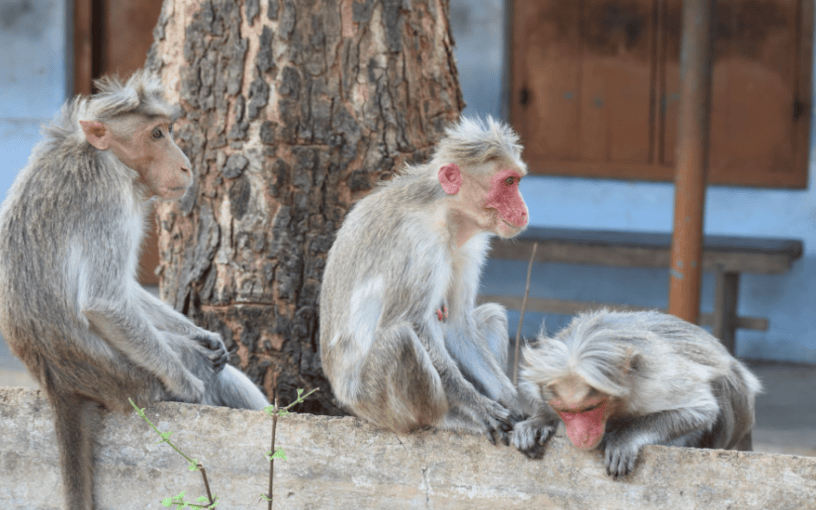
By Krishna N. Balasubramaniam, Sara De Vittoris, Eliza Bliss-Moreau, Brianne A. Beisner, Stefano S. K. Kaburu, Pascal R. Marty, & Brenda McCowan
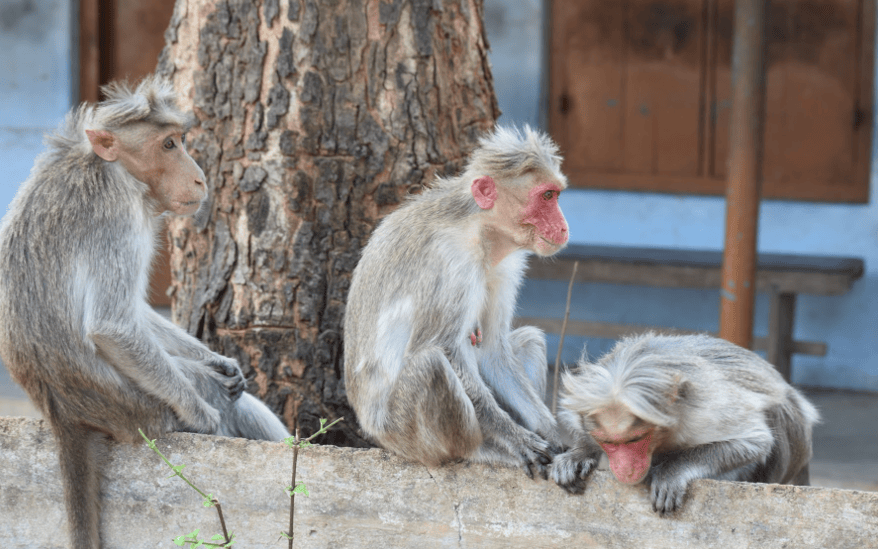
Photo credits: Krishna Balasubramaniam
This Plain Language Summary is published in advance of the paper discussed. Please check back soon for a link to the full paper.
Nonhuman primates (NHPs) are our closest relatives. They share ecological space with us across much of their natural range, where they are also important in terms of conservation efforts to maintain the stability of their ecosystems. Furthermore, many NHPs are also represented in our culture, for instance in folklore, religious symbols, or sometimes illegally in the wildlife pet trade. Therefore, interactions between people and NHPs are some of the most diverse and important of all human-wildlife interactions from social, ecological and conservation perspectives. And yet, we still know very little about what causes these interactions, and the effects that they have on the behaviour of people and NHPs.
In this review, we highlight gaps in research related to human-NHP interactions, specifically within the sub-field of ethnoprimatology which deals with why and where these interactions occur, and their effects on human and NHP behavioural biology. Our review showed how studies of human-NHP interactions have largely evaluated either human or NHP behaviour but rarely both, seldom evaluate differences in behaviour between individual animals, and seldom compare behaviours between different populations or NHP species. We then illustrate and discuss how to address these gaps. Specifically, we describe how the framework of coupled human-natural systems (CNHS) can help us understand human-NHP interactions.
CNHS frameworks have great potential to advance behavioural research in ethnoprimatology, or indeed human-wildlife interactions more generally, especially when combined with estimations of human attitudes, beliefs and experiences towards NHPs, and with mathematical models which predict future human or NHP behaviours. This would be critical for conservation and public health, given that human and NHP behaviours can strongly influence their health and well-being.

