By Gennadi Lessin and Kevin Flynn
This Plain Language Summary is published in advance of the paper discussed. Please check back soon for a link to the full paper.
The accelerating pace of environmental challenges faced by the global ocean and inland waters requires establishing lasting solutions grounded in thorough understanding of these complex systems. This necessitates enhancement of ocean and water literacy (OWL) across all levels of formal education.
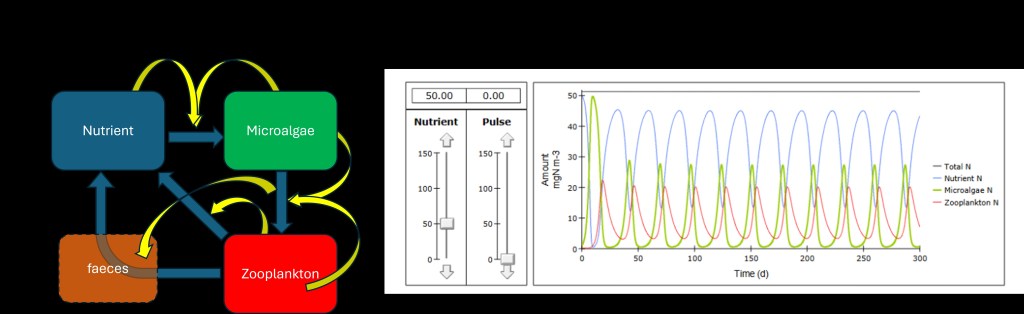
Most of the global issues faced by aquatic systems operate at scales incompatible with direct experience – involving microscopic, remote and long-term phenomena that are challenging to teach in a relatable way. Adopting dynamic simulation modelling, a simplified mathematical representation of reality which considers the rates of flow of material between compartments and displaying events changing over time, offers an interactive approach to teaching that engages students with these less tangible aspects of aquatic environments. Moving beyond static representations of reality, simulation models reveal how ocean and aquatic ecology ‘work’, how things interact and change over time, and uncover the underlying complexity. These simulations thus empower students to explore ‘what-if?’ scenarios, testing responses to perturbations and locating the limits of system stability.
Such simulation platforms readily conform to all the expected criteria for teaching OWL, aligning with, and reinforcing, its essential principles. Despite this alignment, simulation modelling is still rarely used as a teaching tool, and its wider adoption in educational settings requires overcoming several barriers. First, adoption will require development of accessible libraries of ready-to-run, customisable simulation platforms with the involvement of subject experts to ensure appropriate terminology is used in preparing materials for both the students and teachers. Second, clear links to existing curricula must be established, alongside support for teachers and educators through training, development of tailored resources, and establishment of best-practice guidelines. Finally, the distinct role of dynamic simulation modelling among other approaches in environmental education should be clarified and recognised.

