By Karri Neldner, Ebru Peközer, Magie Junker, Lara Abbas, Nayrouz Abbas, Arianna Abis, Federica Amici, Bernardo Arroyo Garcia, Negar Asghari, Zhen Zhang, Junior Peña Chumacero, Aurélien Daviet , Dustin Eirdosh, Nelden Gericke, Tom Herrnsdorf, Tom Hovehne, Dwi Nugraha Jati, Alicia Junker, Patricia Kanngiesser, Ferry Kurniawan, Safaa Mahmoud, Sandra Masaquiza, Risma Illa Maulany, Tongtong Meng, Putu Oka Ngakan, Ljubica Petrović, Kadek Sonia Piscayanti, Mirella Christy Rehatalanit, Maria Inés Sandoval Sernaque, Dennis Shishala, Doriana Sportelli, Roman Stengelin, Thomas Stodulka, Blanca Striegler, Ayşenur Sürücü, Monika Swastyastu, Wanting Sun, Deasry Julita Taek, Sebastian Tempelmann, Ferdiansyah Thajib, Noemi Thiede, Disney Tjizao, Linus Useb, Jonathan Weinmann, Janina Weyrowitz, Lena Woidich, Daniel Haun, and Katja Liebal
This Plain Language Summary is published in advance of the paper discussed. Please check back soon for a link to the full paper.
Experts consider animals as a gateway for children to learn about and connect with the natural world. Whether a child encounters animals in a forest, at home, at school, at a zoo, or through media may influence how those children understand nature and their place within it. Yet, we know surprisingly little about where children around the world interact with and learn about animals in their daily lives.
To explore this question, we spoke with 729 children and adolescents aged 4–17 years living in 23 urban and rural communities around the world. Rather than asking adults what children experience, we asked children directly where they saw animals and where they learned about them.
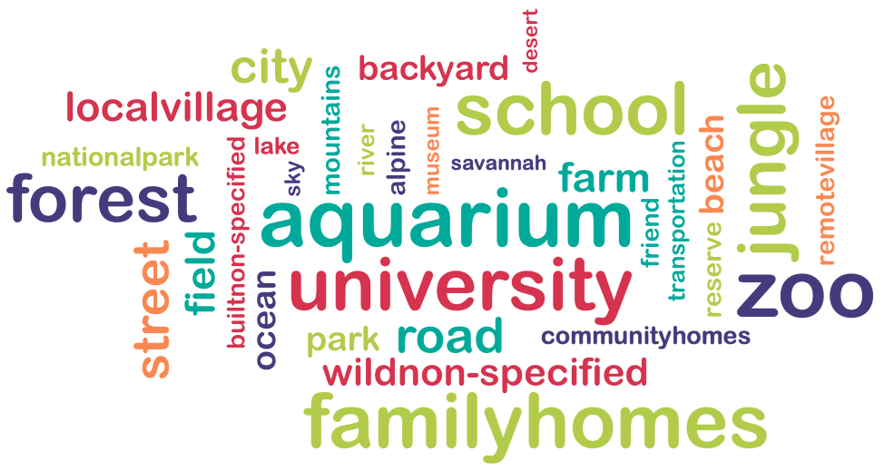
We found that children report engaging with animals and learning about them in many different places. Across diverse communities, children commonly mentioned zoos, forests, and family homes. However, children were generally more likely to report learning about animals in human-built environments, such as homes, schools, and zoos, than in wild environments, such as forests. We also found important differences between communities. Children living in densely populated areas were more likely to describe learning through activities such as school work and classes, while those in moderately populated communities more often mentioned technology and media. Young children living in less densely populated communities were more likely to report learning about animals in natural environments like forests and at the beach.
These findings suggest the cultural, social, and environmental contexts in which children grow up shapes their opportunities to learn about animals. Understanding where children report interacting with animals and learning about them matters because these early experiences may influence their understanding of the living world and formulate the type of connection they feel to nature.
Our study highlights the importance of listening directly to children when designing environmental education and conservation programs. Rather than assuming all children learn about nature in the same way, educators and policymakers can use this information to create learning opportunities that reflect the experiences and environments that are salient to children in different communities around the world.

