By Katie Moon
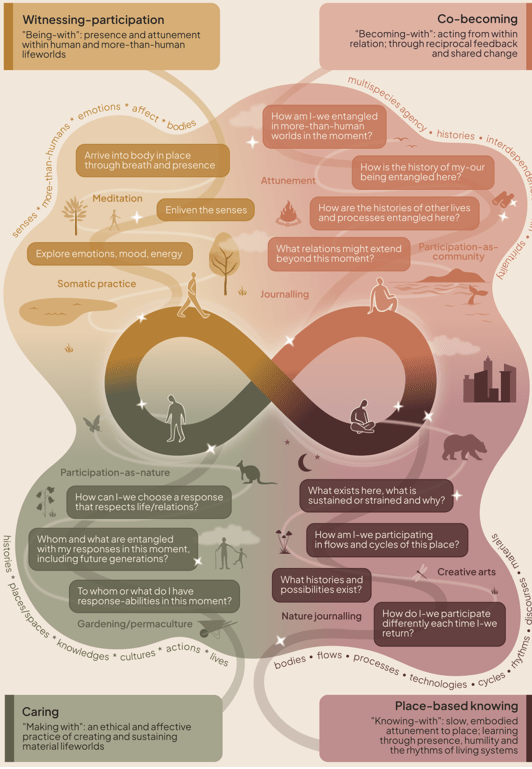
Western society has trained us to see ourselves as separate from nature. Different. Other. But how does our knowledge of the world change when we experience ourselves as nature? This work explores methods and practices to experience reality as a relational being. That is, as a human life that is constantly changing in, and through, its relationships with other people, other species and all matter.
Experiencing ourselves as nature starts not by ‘observing’, but by ‘witnessing.’ Witnessing is a practice that allows us to see that we are always in relation with other lives, rhythms and cycles, from the air we breathe, to the food we eat, to the way animals change their behaviour in response to our presence, all the way to how we change in relation to the movement of the moon and tides and the seasons. These relations and experiences are ancestral – we have evolved to register, to notice and to respond to these relations around us. Relational practice invites us back into this knowing. Next, we can come to learn the processes and cycles of place, by returning, by witnessing and by coming to know how we are interdependent within its relations. Slowing down, considering histories and future possibilities allows us to know place relationally, to experience place as a site of relations. All that we experience is the emergence of the relations of place, from soil to trees, from rocks to cities. We realise here that we co-become with place, that we are entangled with the lives, matter, rhythms and histories of place. We are of place, we belong, and thus, we have responsibilities.
Our practices and actions matter. In tending relations, whether a vegetable garden or clearing trees, we are making and sustaining some worlds, over others. This is relational knowing and practice, and thus care, being wholly attuned to how we are in relation with lives and matter around us and what responsibilities we have to those relations.

