By Bethany Kiss, Sarah Bekessy, Georgia Garrard, Fabio Sweet, Brandon Mak, Wolfgang Weisser, and Casey Visintin
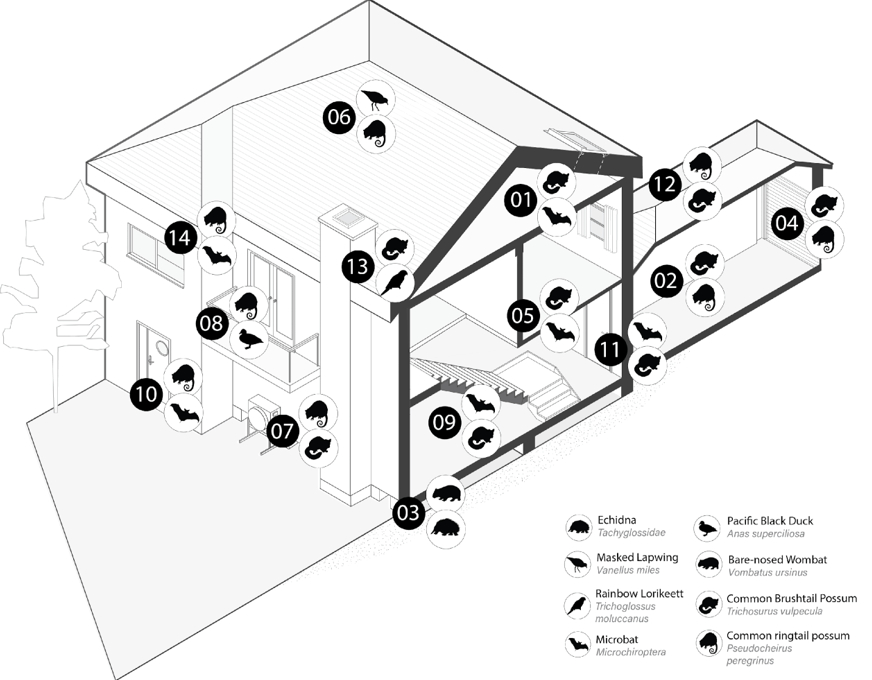
Every day across Australia, many animals make their homes in our buildings. Possums sleep in roof cavities, bats in wall spaces, and ducks nest on balconies. But just how common is this, and which parts of buildings matter most? We reviewed scientific literature on wildlife use of buildings worldwide, then analysed records from Wildlife Victoria, a rescue service that receives calls when people find animals in or around their homes. Across a decade of records (2013-2022), we identified 2,399 interactions (36 native species using 28 different building features) from roof cavities to letterboxes to shower exhaust fans.
Mammals, especially brushtail and ringtail possums and microbats dominated, followed by birds and reptiles. Animals mostly used buildings for sleeping and nesting, while foraging was spread across external features like balconies and doors. What stood out was how closely animals’ choices matched their natural ecology. Tree-dwelling possums gravitated to upper cavities, ground-dwelling wombats sheltered under houses, and microbats sought out wall and roof spaces. Buildings are functioning as substitute habitat, almost entirely by accident.
This matters because older buildings with gaps and cavities are steadily being replaced by sealed modern construction. The habitat some wildlife currently depends on may be disappearing without anyone noticing. Our findings provide a foundation for architects, planners, and policymakers to deliberately design buildings that support wildlife, turning accidental refuges into intentional ones. But making this shift will require more than technical fixes; it calls for changes in education, building codes, and how communities think about sharing their homes with other species.
 Relational Thinking