By Felipe Campos, João David, Ricardo Lourenço-de-Moraes, Lisieux Fuzessy, Neftali Sillero, Pedro Cabral, and Javier Retana
Nature supports people in many ways, from helping to clean water to regulating climate and providing places for recreation. People call this ecosystem services. But where do these ecosystem service benefits appear across real landscapes, and can wildlife help us find them?
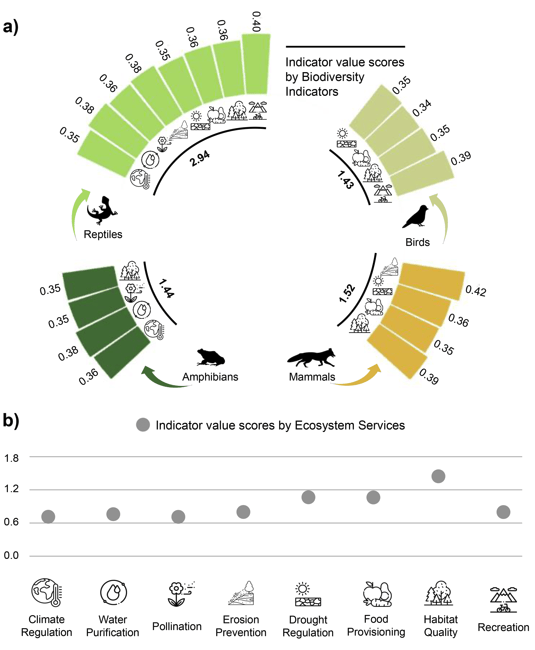
In this study, we use mainland Portugal as a case study to explore that question. We compared the distributions of four groups of land vertebrates, amphibians, reptiles, birds and mammals with maps of eight ecosystem services, including water purification, habitat quality, drought regulation, food production and recreation. We found that reptiles were present in areas richest with ecosystem services. Reptiles were associated with all eight ecosystem services we assessed, while the other vertebrate groups were linked to fewer. Habitat quality was the only ecosystem service connected to all four vertebrate groups. These results suggest that, in this landscape context, terrestrial vertebrates, especially reptiles, may help identify places where biodiversity and multiple ecosystem service supply patterns overlap.
Why does this matter? Because we offer a practical to identify where conservation and land management priorities may support one another rather than compete. More broadly, the study shows how spatial mapping can improve understanding of how biodiversity patterns and ecosystem service supply are organised across multifunctional landscapes.

