By Klara Dietrich, Claudia Bieling, Corrado Ciaccia, and Ingo Grass
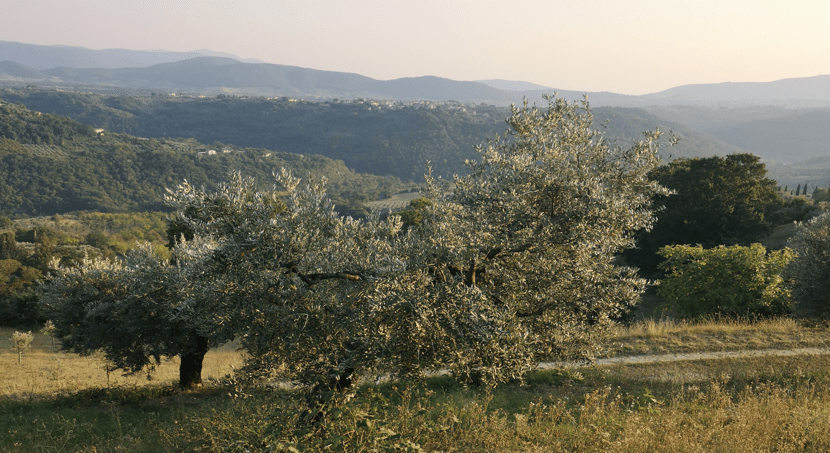
Photo credits: Klara Dietrich
Read the ‘Behind the Paper’ blog here
For thousands of years, olive trees have shaped the Mediterranean landscape. Nowadays, farmers face growing challenges from climate change, biodiversity loss, and rising economic pressure. Our research shows that current farming approaches cannot fully balance different aspects of sustainability. We argue that a shift to agroecology could offer an integrative, transformative path forward.
Today farmers are operating between three main types of farm management:
- Traditional: Low-intensity, manual labour and high heritage values
- Conventional: Large-scale monocultures focused on maximizing economic returns
- Sustainably Intensified: High-tech and precision tool usage to improve sustainability
To better understand the functioning and outcomes of these systems, we reviewed 46 scientific studies and compared how they perform in four areas: environmental integrity, economic resilience, social well-being, and good governance. Most studies focused mainly on economic returns and environmental impacts, while paying much less attention to people’s well-being and governance. Our results show clear trade-offs between the sustainability dimensions:
Traditional systems help preserve cultural heritage, but they are often not economically viable and not very resilient to climate stress. Conventional systems produce higher yields, but they can harm the environment and reduce long-term resilience because they rely on intensive inputs and simplified landscapes. Sustainably intensified systems try to combine high productivity with environmental protection, but they depend strongly on external technologies and often do not adequately address social equity or reliance on external inputs.
This is why we argue that small improvements to current systems are not enough. A shift towards agroecological farming implies a more holistic scope and integrates environmental, social and economic dimensions to the transform the entire agri-food system. More concretely, and even though research in this area is still limited, agroecological practices such as planting cover crops, reducing soil disturbance, and lowering machinery use can benefit the environment. At the same time, farmer cooperation, knowledge sharing, and diversified income sources can strengthen resilience and social well-being. Overall, our study suggests that the future of olive farming depends on a broader transformation, one that brings together environmental, economic, social and political solutions.

