By Mitchell Whitelaw, Adrian Mackenzie, Martin Westgate and Kylie Morrow
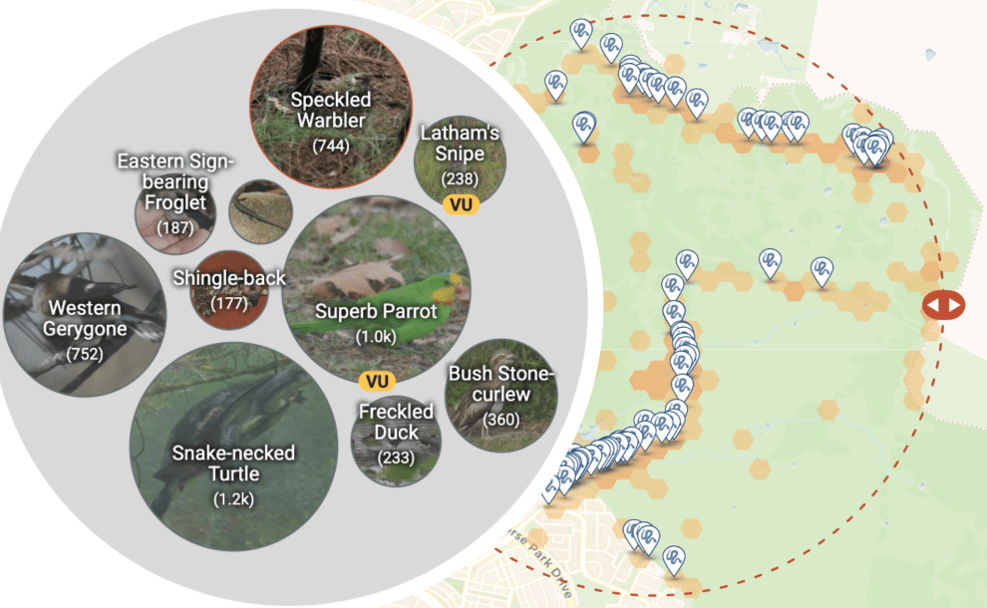
Biodiversity data — digital records of non-human life — is collected and circulated widely, from citizen science platforms to national and international institutions. The interfaces to biodiversity data shape how we see and understand it.
In this paper we show that relationships between species and place are often hidden in biodiversity data interfaces. By grouping and ranking observations according to the most commonly observed species, much of the variation that makes one place different to another is concealed.
In response we designed an experimental interface for a public Australian data platform, the Atlas of Living Australia that demonstrates a new approach, uncovering species with connections to place. These connections are a characteristic feature of all biodiversity; they are also important for people in supporting our sense of place, and attachment to place.
Using this interface to investigate data from sites around our city of Canberra, Australia, we show that it uncovers local natives, as well as other species with different forms of connection. Observers caring for local reserves record invasive plants, for example; and volunteers record turtles found at the boundary of a fenced conservation area.
As these examples show, biodiversity data reflects human connections to place, as well as human organisations, institutions and projects. It also reflects nonhuman life in place, through habitat, movement and ecological relationships. These two joined aspects offer a new perspective on biodiversity data.
Our work shows why interfaces to biodiversity data matter, and how they can be re-designed. We developed a new approach that reveals the connections between species, place, and people. Nature recovery depends on these connections, and we argue that interfaces like ours can support them.

