By Naoki Saito, Soyo Takahashi, and Akira Iguchi
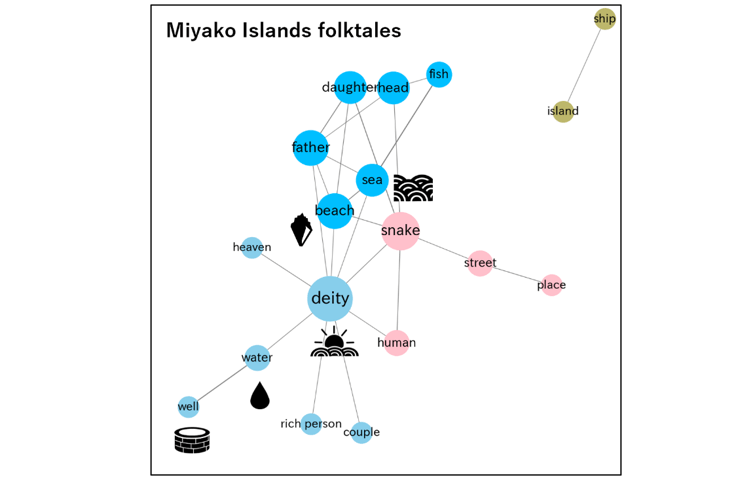
Nature matters not only because it provides resources, but also because nature is a meaningful part of human relationships. In the Ryukyu Islands of Japan, for example, there is a unique and deeply rooted system of nature worship. People view many natural landscapes as sacred and thus reserve these landscapes for sacred purposes. However, it is often difficult to assess such traditional values of landscapes in ways that can inform environmental conservation.
Here, we explored whether a large-scale analysis of folktales could help reveal the traditional values of sacred landscapes. Using a method called text mining, we analysed more than 30,000 folktales from across the Ryukyu Islands. Focusing on words related to landscapes, such as ‘sea’, ‘mountain’, and ‘well’ (representing traditional wells, known as ‘ga’ that often use natural springs), we measured how closely they were associated with the word ‘deity’ in folktales.
We found clear regional differences. In folktales from two regions, the Miyako and Yaeyama Islands, words such as ‘sea’, ‘beach’, and ‘well’ were strongly linked with ‘deity’, suggesting that these landscapes served as important settings for stories involving deities. In the Miyako Islands, where fresh water is scarce, ‘well’ showed a particularly strong association with ‘deity’, highlighting that people have traditionally regarded wells as sacred.
Our findings show that conserving these waterside landscapes is important not only for ecology, but also for culture. In addition, our method has the potential to be applied to folktales from other regions. Overall, we suggest that large-scale folktale analysis may offer a new way to recognise traditional values of nature and support conservation from a humanities perspective.

