By Dian Spear
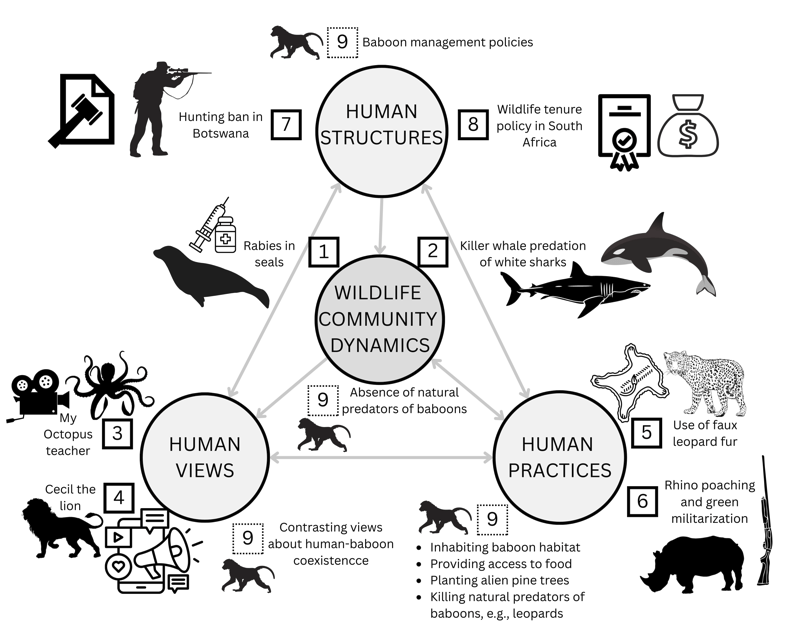
In a world where there is an increasing need for people to coexist with wildlife, people’s relationships with wildlife are dynamic and evolving. Changes in relationships between people and nature emerge from four interacting forces: (1) changes in wildlife communities that cause shifts in animal movement and behaviour; (2) changes in structures, such as governance systems; (3) changes in human views, such as through emotive storytelling in the media; and (4) changes in practices, such as hunting.
I examined nine examples from the marine-urban interface in Cape Town and rural Southern Africa to better understand these changes and how they reshape people’s values, experiences and interactions with wildlife. The case studies included rabies outbreaks in Cape fur seals in Cape Town, the disappearance of white sharks from Cape Town due to killer whale predation, the global reaction to the killing of Cecil the lion in Zimbabwe, the influence of the Cape Town-filmed documentary My Octopus Teacher, the use of faux leopard fur in cultural ceremonies in Zambia and South Africa, and the impacts of rhino poaching and militarised conservation in Kruger National Park in South Africa. Together, these cases show that people’s relationships with wildlife are dynamic and often contested. A single species might be seen as a cultural symbol, a threat, a source of income, a cherished neighbour or all of these at once. Some of the cases also reveal that media, technology, and distant events increasingly shape these relationships. This means that human-wildlife relationships are shaped by much more than direct encounters.
Understanding how and why relationships between people and wildlife change can help us design more inclusive and effective approaches to human–wildlife coexistence. By paying attention to the emotional, cultural, political, and ecological dimensions of these relationships, we can make better decisions that support both people and nature, especially in places where conflict, rapid change, and competing values are the norm.

