By Sonia Graham, Melanie Wary, Fulvia Calcagni, Mercè Cisneros, Claudia De Luca, Santiago Gorostiza, Ola Stedje Hanserud, Giorgos Kallis, Panagiota Kotsila, Sina Leipold, Jagoba Malumbres-Olarte, Tristan Partridge, Anna Petit-Boix, Anke Schaffartzik, Galia Shokry, Sergio Tirado-Herrero, Jeroen van den Bergh, and Patrizia Ziveri.
To keep global temperature increases below 2°C, natural and social scientists need to work together better. In this paper, we argue that the idea of tipping points can bridge the divide between these two fields of study, leading to integrated knowledge that can better inform climate change policy and practice.
For decades, natural scientists have studied climate change primarily by describing and studying changes to the natural environment. The emphasis has been on documenting rises in global temperatures, changes to rainfall patterns and extreme weather events. More recently, natural scientists have asked questions about whether the changes we are witnessing are reversible. Is there a tipping point at which, no matter how much we curb our greenhouse gas emissions, the environmental changes will be permanent?
While these environmental questions are important, we argue that they need to go together with social questions about how we behave as individuals, groups and societies. To make sure we have a sustainable future, we need to know how environmental and societal changes are interconnected. We need to ask: Who benefits from and contributes the most to the current trajectory? What are alternative, more desirable scenarios, and can we intentionally work towards them? Are there social tipping points that could help us rapidly change our practices, norms, and institutions towards those scenarios?
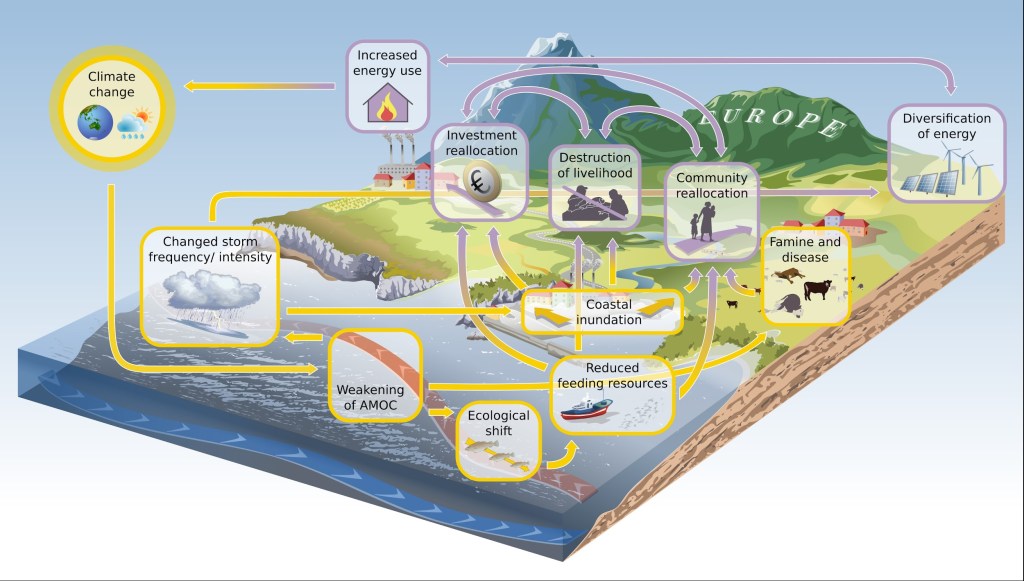
We use the climate-change-caused slowdown of the Atlantic Ocean currents, and the associated flooding of the Ahr Valley in Germany, to show the value of studying social and climate tipping points together. In this example, it is possible to see how extreme weather events impact local communities and, in turn, how those communities change their ways of life to accommodate future extreme events. By studying environmental and social changes together, we can understand how climate change and society interact. This helps us determine if our responses are benefiting everyone or just some of us. It also helps us see the consequences of our actions at different scales: local, national, and international.
 Relational Thinking