By Eran N. Schwarzfuchs, Daniel E. Orenstein, Dror Ben-Ami, and Tamar Dayan
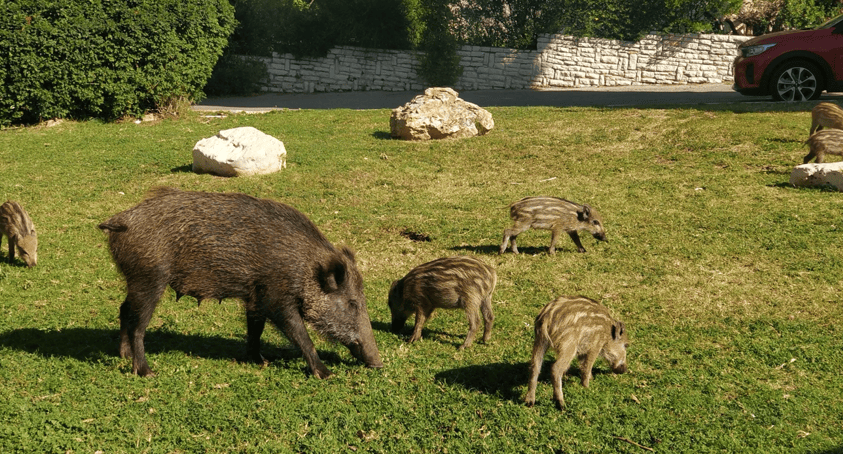
Many cities decide what to do about nature by counting reports about human-wildlife interactions. A wild boar tips over a bin, and someone picks up the phone or opens an app to tell the city. Those reports become a database, the database becomes a map, and the map helps city leaders decide where money goes. It is an efficient way to run a city, and a strange way to know the natural world.
People usually see such data as messy, requiring cleaning to get closer to the truth. We suggest something different. A reporting system is not a faulty instrument pointed at nature. It is civic machinery that decides in advance which human-nature encounters become something a city acts on. An encounter nobody reports does not exist as far as the municipality is concerned. The question is not only where the animals are, but whose experience of them is written down.
We modelled the same reports twice: once using only the physical features of a place and once adding who lives there. The difference is usually treated as error. We think it is informative, and inherent to these data, because it describes the relationship between people and nature in the city rather than the animals themselves.
Reporting can be skewed in two opposite directions. It can fall short. In Haifa, Israel, how well off a neighborhood was was the strongest clue to where wild boar reports came from, and mostly poorer, Arab and ultra-Orthodox neighborhoods, otherwise much like heavily reporting ones, barely called at all. Or reporting can overflow from one loud source. In the town of Mitzpe Ramon, nearly half the reported trouble with Nubian ibex came from a single luxury hotel, so the city hears about the guests’ encounters with ibex and hardly at all about the residents’.
This not only a question of data quality. People in the quiet neighborhoods live with the boars too, they just lack the attention reporting brings. Nor can the two sides be pulled apart. In Haifa, the greenest, most boar-friendly streets are the wealthiest. Collecting more calls will not fix this. The reporting is part of what is measured. It, too, is data. Which relationships with nature become evidence, and whose do not, is a choice cities make every day.

