By Carsten Meyer
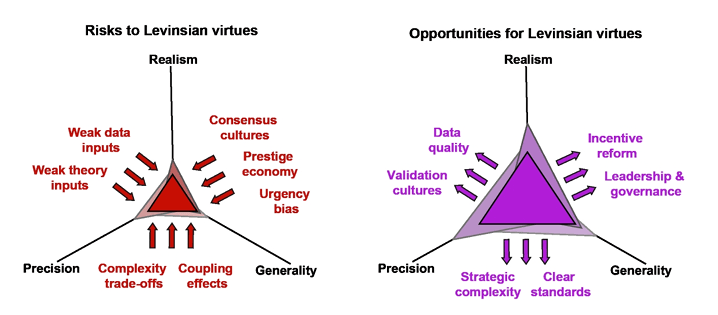
Large computer models are widely used to guide decisions on climate change, biodiversity loss and land use. These models link many parts of the human and natural world – such as the economy, farming, forests and ecosystems – to explore how changes in one area can ripple through the system. Policymakers often rely on them to compare future scenarios and assess risks.
In this Perspective, I examine how reliable these broad, interdisciplinary models really are.
I argue that three basic qualities make a model scientifically useful: it should be reasonably accurate, work across different contexts, and reflect how the real world functions. Yet all three are often limited by the same underlying problems.
First, global data are biased and incomplete. Some regions and processes are well documented, others are not. Models are thus often built on patchy or biased data. Results of different models vary strongly. Sometimes, this variation is much more driven by the specific data choices than by differences in the future scenarios being tested. This undermines our very ability to compare different future scenarios.
Second, many of the theories used inside these models have not been tested across the wide range of places and scales where the models are applied. When models link several components together, they create indirect cause-and-effect chains that may be less broadly valid than the simpler relationships they are built from.
Third, adding more detail does not automatically make a model more realistic. If new processes are poorly measured or weakly understood, extra complexity can increase error rather than reduce it.
Finally, modeling is shaped not only by scientific goals, but also by funding pressures, publication incentives and policy timelines. These factors can discourage careful validation and long-term improvement.
I suggest that improving these models will require coordinated efforts across the scientific and policy communities – including stronger data foundations, clearer validation practices and incentives that reward transparency and long-term quality.

