In this new blog post Peter Bridgewater, People and Nature Associate Editor, discusses their highlights of the recently published Research Article ‘Assessing relational values of sacred landscapes through text mining of folktales: Insights from the Ryukyu Islands, Japan’.
The recent publication in People and Nature by Saito et al. Assessing relational values of sacred landscapes through text mining of folktales: Insights from the Ryukyu Islands, Japan is an interesting chapter in the story of language and nature. The Convention on Biological Diversity (CBD) used the “Index of Linguistic Diversity” (Developed by Terralingua (http://terralingua.org/our-work/linguistic-diversity/) as an indicator for target 18 of the (failed) Aichi targets. Unwisely, this was not developed in the Global Biodiversity Framework, which whilst mentioning Indigenous and other knowledges in target 21 does not deal with language per se, and seems to have disappeared.
This was a potentially wonderful opportunity missed, and the paper by Saito et al provides excellent thinking to remedy this. They have used text mining of over 30,000 folktales from the scattered archipelago that are the Ryukyu islands to identify relational values and seek differences between the islands. The Ryukyu archipelago, stretching along the south of Japan towards Taiwan, has complex geology and human history, with many language variants, abundant folktales unique to each island in the chain, and so makes an ideal study area using folk tales as the medium.
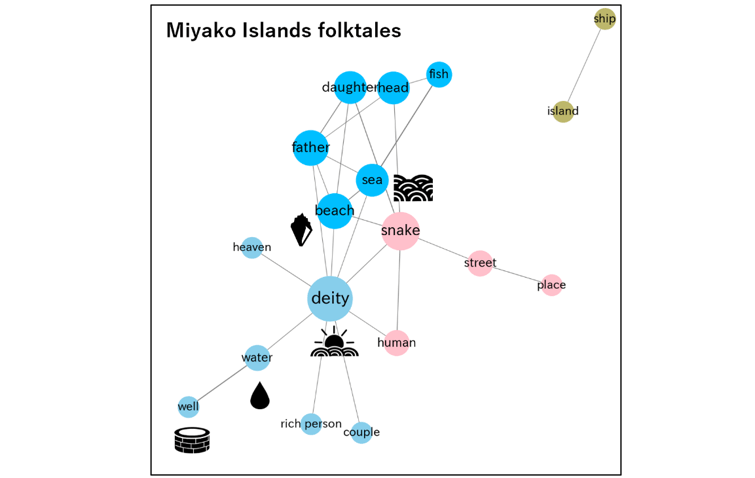
The results are clear – in two regions, the Miyako and Yaeyama Islands there was strong co-association between deity and sea, beach and well, emphasising the roles these landscape features play vis-a-via deity worship. Beach and sea relate to harvesting of marine resources for food and other human well-being benefits. Availability and management of water resources is clearly important to small island communities. The authors show how for the Miyako Islands, where water is scarce well and deity show strong co-occurrence, highlighting that through human history of these islands wells and water have been regarded as sacred,
Some while back I tried, alas unsuccessfully, to introduce the concept of the Linguasphere, building on the ideas of noosphere promulgated by Teilhard de Chardin and others. It seemed to me then that language was the quintessential vehicle for biocultural communication and idea transmission, building the decade old paper of Kai Chan et al on relational values. The linguasphere can define both the envelope of human communications and the envelope of human cultural exchanges. Many authors have described how languages decline due to destruction or change of the habitats and ecological bases of the speakers—creating endangered languages, in parallel to the more familiar case of endangered species (and, less often identified but equally critical, endangered spaces or ecosystems). Indeed, postulated extinction rates for languages parallel those for species over the next century—and the forces for extinction are essentially the same, biotic, and cultural homogenization of people and landscapes – called by some the Homogenocene.
The linkage between languages, cultures, and the landscape/seascape in which they developed, poses the question: “Is the maintenance of cultural and linguistic diversity really comparable to the maintenance of biodiversity?” The answer is clearly yes: while knowledge about the natural world may be encoded in an indigenous language, that same knowledge is not retrieved easily through other languages that lack specific vocabulary and ideas to describe local biodiversity and resource management practices. Saito and colleagues use this idea of linking relational values and language to help understand the importance of conserving specific landscape features, important for the continued health and sustainability of villages. Their work on the Ryukyu islands language variants expressed through folktales and its links to landscape elegantly illustrate that point, and their clever use of modern techniques such as text mining point the way for other studies to be undertaken in bio-culturally rich areas of the world.
Well worth a read, and, if your skill set allows, some follow-on work!

