In celebration of the shortlisted papers for the Rachel Carson Prize 2023 for Early Career Ecologists, we’re delighted to introduce you to some of our shortlisted individuals and papers.
Paraecology for Community Bushmeat Hunting Monitoring, Modelling, and Management.
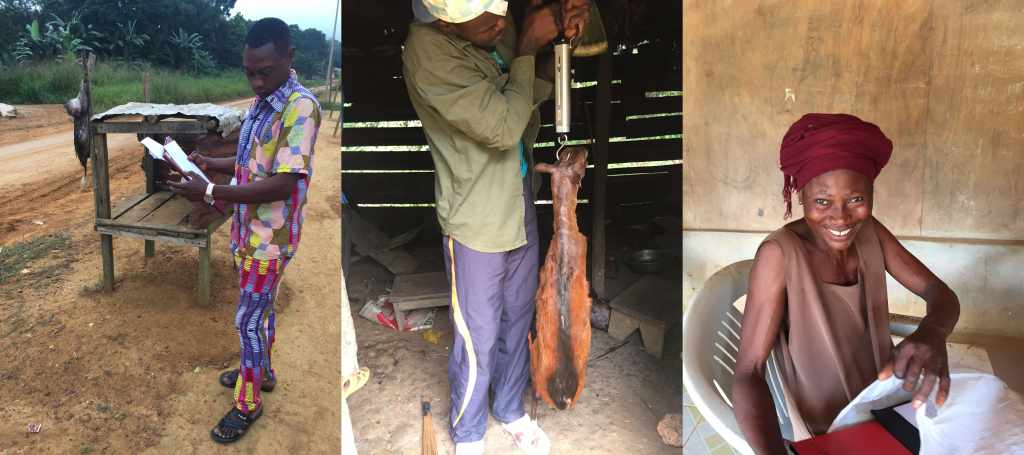
Paraecologists from left to right conducting village bushmeat transects (Jonas Landry Metandou), weighing bushmeat following a hunter GPS self-follow (Irma Ngoboutseboue), and reviewing data (Charlottte Bayossa). Jonas and Irma worked with the hunters and are co-authors of the shorlisted paper.
Photo by Graden Froese.
Our paper examined fluidity in the individual motivation for the rural use of common-pool resources (CPRs) in social-ecological systems (SESs). Specifically in the context of hunting for income and food, known as bushmeat in the Congo Basin of Central Africa (the world’s second largest rainforest!). Bushmeat is essential to local nutrition, income, and culture. And the way it is thought about in both science and policy is evolving. But hunting for bushmeat is rarely linked to wider CPR and SES theory – we wanted to make that link explicit.
This specific paper’s greatest importance may be its methods (but we hope not in a boring way!). Over a hundred gun and trap hunters across nine villages in Gabon generated data in a participatory process whereby hunters conducted GPS self-follows in conjunction with paraecologist surveys of their motivation, behaviour and offtake (animals hunted).
Some of our results were surprising (ex. increasing number of traps didn’t increase offtake) and others were expected (ex. gun hunters that walked farther hunted more) but had not previously been empirically shown because it’s been so hard to get this much data.
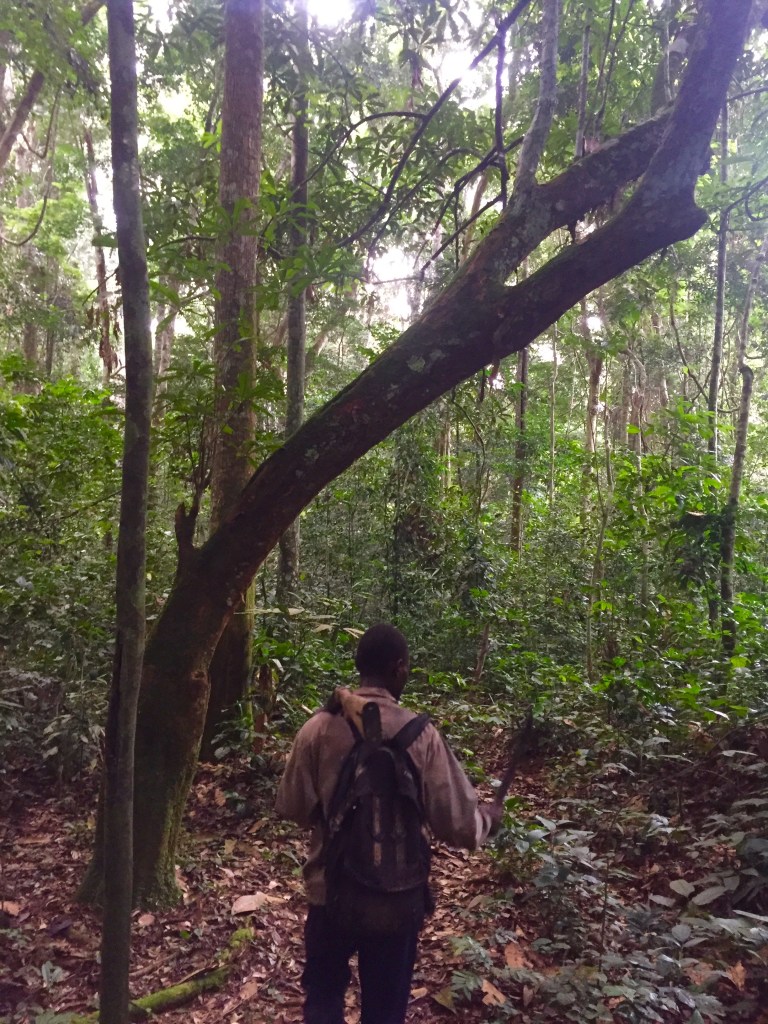
Photo by Graden Froese.
We show that working with communities, and with dedicated and paid paraecologists, will generate a higher quality and quantity of data than typical science. It is also important in the movement for more ethical scientific publishing as all paraecologists are co-authors (as we sadly know, those who collect the data in the Global South are so often excluded from authorship).
Lastly, the statistics weave the oft-disparate statistical advances of structural equation and Hierarchical Bayesian modelling. I haven’t seen that done before (at least in our field). The paper gives a thorough example from notation to (online) code to figures. I found such start to finish examples in general lacking when teaching myself Bayes, and wrote the paper to be a learning tool for young scientists across disciplines.
Speaking of stats, this other two paper doesn’t address the other two Ms in the title. We’ve previously published the monitoring programme for those curious. The management results are inspiring, exciting…and forthcoming! We are also, roughly five years later, about to conduct another year of data collection and see how things are changing with time. All this while we are working closely with the Gabonese government in their ongoing revision of hunting policy. The goal is to make bushmeat as sustainable and equitable as possible by enabling self-determined community governance and management of hunting.
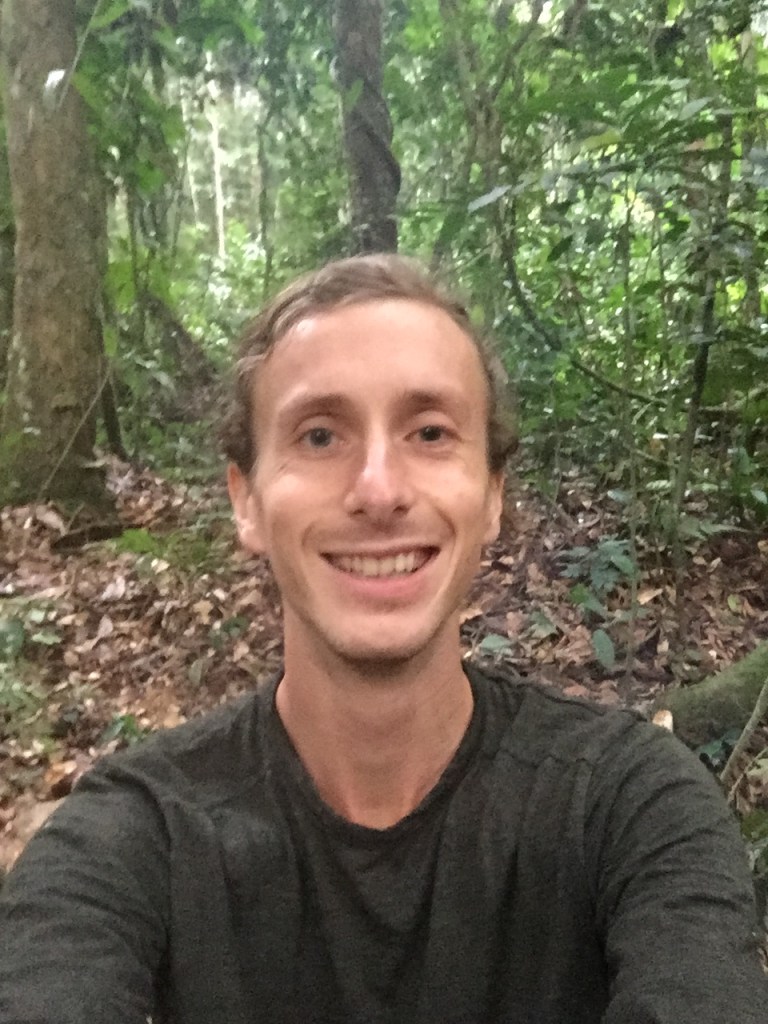
I am a boundary spanner with the Nsombou Abalghe-Dzal Association (NADA; https://nadagabon.org), a Gabonese rights-based conservation NGO who strives for the “Sustainable and equitable governance and management of ancestral lands and biocultural diversity, established and maintained by Gabonese Indigenous Peoples and local communities”. My own day to day work is fluid: research, policy, fundraising, etc.
I grew up on Coast Salish lands and waters in the town of Chemainus, on what is now known as Vancouver Island in western Canada. My dad is a fisherman and rural family doctor, my mom a naturalist, artist, and educator. So I was born into respect and joy for nature and the people who live in and of(f) it. I like to spend my time in the bush…but this is becoming less frequent. So I observe the daily rhythms of all that is always there: watch the clouds, listen to the backyard birds, chat with the neighbours. Nap, drink tea, read. A novel that recently moved me is Les lieux qu’habitent mes rêves by Felwine Sarr.

