By Daniel Pratson, Nick Adams, and Rachelle Gould.
Read the full paper here.
Scientists and policymakers are motivated to investigate how people value nature, given the links between human and environmental wellbeing. Relational values refer to the principles and preferences people hold in reference to relationships between themselves, their communities, and nature; they represent one way to characterize how people value nature.
Scholars argue that the relational values concept better describes values sometimes underrepresented in political and economic decision-making. Consider a farming family and their land: economic values may describe trends in the profits the family earns from selling crops, but relational values describe how familial heritage and local culture influence the management decisions made on their land. Relational values contribute to an understanding of communities’ plural values of nature, which can lead toward just and equitable environmental decision-making.
Many scholars have investigated relational values in empirical research. We reviewed 72 publications from a subset of these research projects to summarize trends of past research and to inform future research. Research on relational values has increased substantially since 2017 and has taken place across 6 different continents. Researchers have used a range of methods, some including surveys, interviews, and choice experiments, to investigate relational values.
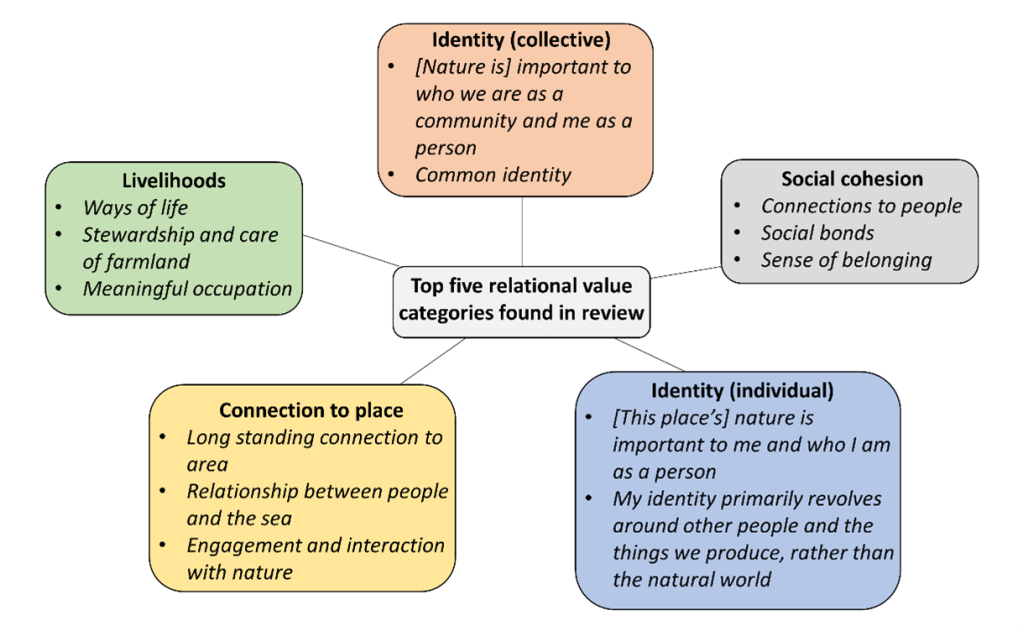
We also summarized what scholars identified as relational values. We identified 312 unique words or phrases identified as relational values, which we grouped into 17 different categories. Relational values most commonly fell into the following categories:
- Individual identity
- Collective identity
- Social cohesion
- Connection to place
- Livelihood
Notably, we found that many studies took an inclusive approach when identifying relational values and did not always justify how their results were in support of literature that establishes relational values as a unique concept. We suggest that scholars explicitly state how values they identify in their research are based on non-substitutable relationships between people and nature.
The relational values concept has been adopted by policy bodies (such as the Intergovernmental Science-Policy Platform on Biodiversity and Ecosystem Services) and will likely influence environmental decision-making – we hope that our review will encourage future relational values research to strive for conceptual cohesion.
 Relational Thinking