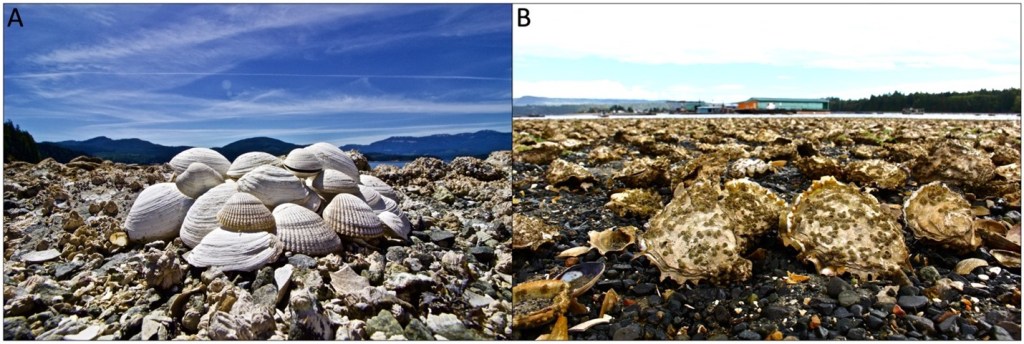
Photos taken by Kieran Cox.
By Kieran Cox, Hailey Davies, Ben Millard-Martin, Morgan Black, Margot Hessing-Lewis, Nicole Smith, Francis Juanes, and Sarah Dudas.
Coastal communities have relied on shellfish for thousands of years. This nutritious food is accessible from shore and has contributed to the creation and maintenance of economies, governance systems, and resource management practices. Shellfish cultivation continues to benefit coastal communities, as this is one of the world’s fastest-growing food systems.
We studied two different ways of growing shellfish that are used throughout the northeast Pacific: Indigenous clam gardens and shellfish aquaculture farms. Clam gardens have been engineered over millennia by Indigenous Peoples, while shellfish aquaculture farming began in the last century. These distinct techniques both aim to increase the abundance of clams and allow for sustainable harvests. We observed that both techniques create unique clam communities and considerably increase the amount of intertidal clams. Among other things, we found that more complex modified shellfish habitats supported a greater diversity of clam species.
This work contributes to the mounting evidence that shellfish cultivation provides a way to increase food production, raise awareness of different cultivation strategies, and increase our understanding of the processes that shape coastal ecosystems. The importance of these concepts is well-known by those who harvest or cultivate shellfish, and we believe this knowledge can significantly improve the management of coastal resources.
 Relational Thinking