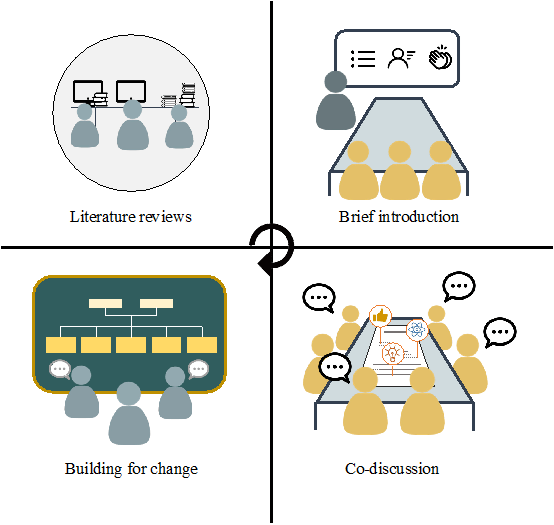
(Image designed by Kaiwen Zhou)
By Sifan Hu, Zhijian Liang, Kaiwen Zhou, Diogo Veríssimo, Tien Ming Lee, Xiangdong Ruan, and Amy Hinsley.
Read the full paper here.
Co-design is an approach that effectively gathers multiple stakeholders’ perspectives and unique knowledge and experiences on behavior change interventions. It represents a shift away from expert-led design towards using the collective creativity of a team from different backgrounds, where target audiences are actively involved as designers. This process could contribute to developing inclusive and feasible ideas that better address the audience’s needs. In the conservation context, wildlife consumption is a complex behavior that involves a variety of stakeholders, which makes developing audience-oriented behavior change interventions even more crucial. Yet, we know little on how to apply the co-design approach to the wildlife trade sector.
The aim of our study was to apply the co-design approach to the wildlife consumption context, to develop interventions that aimed at reducing illegal wildlife consumption, and to provide academic researchers or conservation practitioners with a detailed guide on the co-design approach in other settings to develop feasible and inclusive interventions that are locally relevant. Our research team conducted three co-design workshops in China with key stakeholders (consumers of animal-based medicines, pharmacy workers who sell them, and Traditional Chinese Medicine doctors who prescribe them) to develop intervention prototypes on reducing illegal animal-based medicine consumption.
We identified five main pathways of interventions from our co-design process, including two inclusive solutions that may have been previously overlooked. They are an intervention to promote the appropriate use of Traditional Chinese Medicine and another to increase consumers’ capacity to identify legal products. Our co-design prototype also enhanced existing views related to the role of medical practitioners in health-risk communication. Nevertheless, some co-design ideas may need the involvement of a wider range of stakeholders for further intervention development.
We showed that the co-design process could integrate multiple stakeholders’ perspectives effectively in the ideation stage, and has the potential to produce inclusive intervention designs that could drive innovation in conservation efforts to reduce illegal consumption of a range of wild species. We used our co-design process and reflections on its application to wildlife trade sector to provide detailed guidelines for future conservation program planning in the broader conservation context.
 Relational Thinking