By Megan Shaw, Lordeana Tirlea, William Borrie, Emily McLeod, and Kelly Miller
This Plain Language Summary is published in advance of the paper discussed. Please check back soon for a link to the full paper.
Have you ever paused on a photo of a koala and felt a sudden tug on your heartstrings? Maybe you smiled at a close-up of a curious bird or felt despair seeing an orangutan sitting in a deforested patch of what was once rainforest? We wanted to know whether these feelings, which pictures of wildlife generate, can shape how willing people are to take action for wildlife.
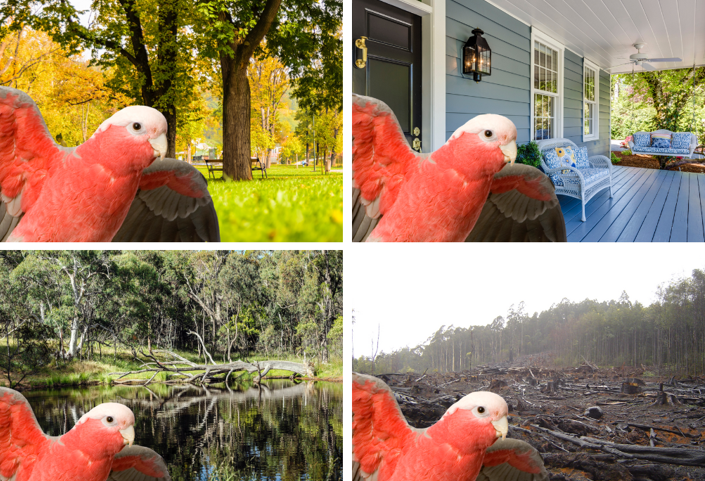
We focused on the Galah, a much-loved Australian bird. We created over 100 images of it in different settings; from healthy bushland to degraded landscapes, and even familiar settings to us, like back gardens, parks and train stations. Some photos showed the bird up close, others at a distance. We then asked over 2,000 Australians to look at one of these images, tell us how it made them feel, and report how likely they were to do things like volunteer for conservation, donate, or create a wildlife-friendly garden.
Our results suggested that imagery may be more powerful than we’d expect. Close-up photos made people feel stronger and more positive emotions than distant shots. Images with natural or house/garden backgrounds also created warmer, more positive feelings, while degraded settings made people feel less positive. And here’s the key, when people reported strong, positive emotions, they were also more likely to say they would do something to help wildlife.
That said, emotions weren’t the whole story. The effect was real, but relatively weak, so a single image is unlikely to spark major behaviour change on its own. Still, our results suggest that the right photo can nudge people in the right direction, especially when paired with clear and hopeful messages about how they can help.
For conservation campaigns, this means pictures shouldn’t just be an afterthought. Choosing an image that makes people feel something (whether that’s a bird looking straight at the camera or wildlife shown in everyday spaces), can make a real difference. It’s not just about raising awareness; it’s about sparking a feeling that leads to action.
 Relational Thinking