By Virginia Morandini and Álvaro Soutullo
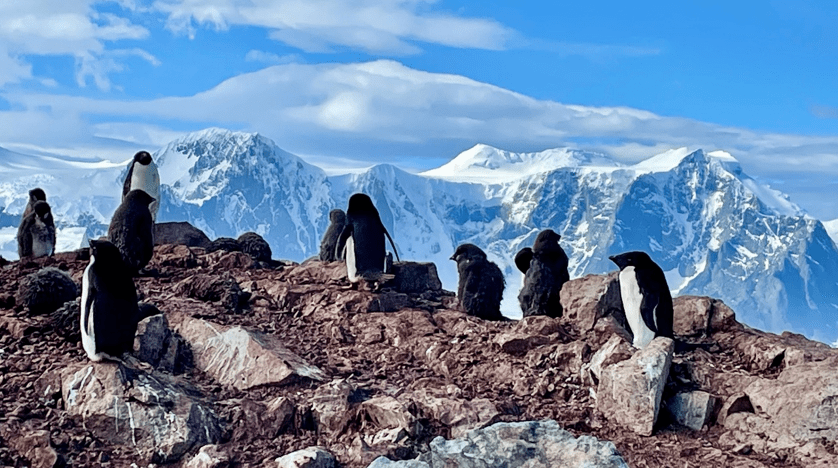
Photograph: Virginia Morandini
This Plain Language Summary is published in advance of the paper discussed. Please check back soon for a link to the full paper.
Antarctica is often seen as a global success story: a continent protected through science, international cooperation, and environmental agreements. However, our study argues that this image hides an important problem. Although scientific research in Antarctica has grown rapidly, much of this knowledge is still not helping decision-makers respond in time to protect the continent.
We describe this problem as epistemic opacity: a situation in which large amounts of scientific information exist, but remain fragmented, difficult to combine, and poorly connected to political decision-making. Antarctic science generates many observations, but often lacks the integrated understanding needed to support long-term governance. Research is frequently shaped by short funding cycles, national priorities, and the search for scientific visibility, rather than by the long-term ecological questions most relevant for conservation.
This fragmentation weakens the ability of international institutions to respond to emerging threats such as climate change, expanding fishing and tourism, and future pressure to exploit mineral resources. A key moment is approaching in 2048, when the legal conditions for revisiting the ban on mineral extraction in Antarctica may become less restrictive. If Antarctic science remains uncoordinated and weakly connected to governance, decisions about the continent’s future may be made without robust and shared evidence.
Our study argues that the solution is not only to collect more data, but also to organize science differently. Long-term ecological research should be treated as a shared responsibility rather than as an optional scientific activity. Valuable monitoring programs and observatories already exist, but they are rarely well connected across disciplines or designed to directly inform policy.
Antarctica offers a rare opportunity: it is one of the last places on Earth where we can still understand ecosystems before they are irreversibly altered. But this opportunity is closing. Without changes in how Antarctic science is coordinated and used, we risk losing not only species and habitats, but also the knowledge needed to govern collectively under global environmental change.
 Relational Thinking