By Fang Wang, Haibin Chen, Liqun Shao, and Shuai Wang
This Plain Language Summary is published in advance of the paper discussed. Please check back soon for a link to the full paper.
Rivers and watersheds do not follow the administrative boundaries that humans set. When prefecture-level cities in a river basin manage their own water separately, it often fails because what happens upstream always affects those downstream. For water governance to work well, local governments need to collaborate across administrative borders.
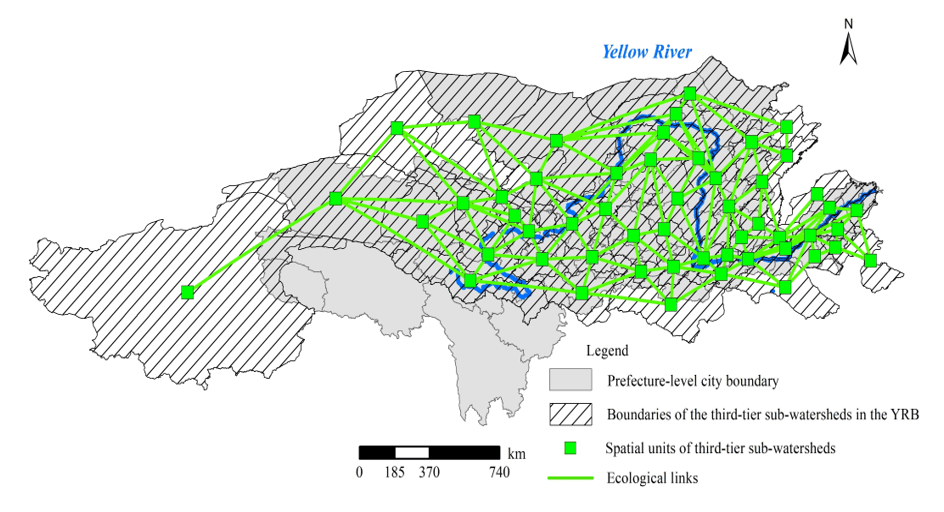
We studied how such collaborations form in China’s Yellow River Basin. We built a network model to examine whether the natural links among sub-watersheds, and shared jurisdiction over the same sub-watersheds, drive prefecture-level cities to work together.
Our analysis found that prefectures are more likely to collaborate if they share the same sub-watershed, or if their sub-watersheds are naturally connected. This suggests that policy actors do respond to ecological realities when building partnerships. We also observed that local governments tend to form tight, closed groups rather than open star-shaped networks. This pattern indicates that cooperation problems in the basin are perceived as high-risk, and policymakers prioritize building trust and securing commitments over simply exchanging information.
These findings show that cross-regional collaboration in a China’s centralized, top-down political system is not simply commanded from above. Instead, it emerges in ways that respond to the natural environment and the specific challenges of collective action in water governance. Understanding these dynamics can help design more effective and resilient collaborative water management in large river basins worldwide.
 Relational Thinking