By Fabricio C. Albuquerque, Guilherme O. Longo, Luiza S. Waechter, Mariana Bender, and Filipe M. França
What was the inspiration for this article?
Working with traditional fishing communities in Northeast Brazil, we wanted to better understand how fish diversity supports food and nutrition security, and what might be at risk if species are lost due to overfishing, habitat degradation, or climate change. So, this article was inspired by a simple but urgent question: what could happen to people’s nutrition when marine biodiversity declines?
How does your article inform future research?
Our study highlights the importance of looking beyond the quantity of caught fish to consider their nutritional quality. By integrating food consumption data with nutrient composition and simulated species-loss scenarios, we show that biodiversity plays a key role in shaping dietary outcomes. This opens new avenues for interdisciplinary research linking ecology, nutrition, and social–ecological systems. Future studies can build on this approach in other regions, incorporate additional nutrients, and explore how fisheries management can explicitly account for nutritional value in decision-making.
Why did you choose People and Nature for your research?
People and Nature is an ideal home for this research because the journal focuses on the relationships between humans and the natural world. Our study sits precisely at this interface: it connects marine biodiversity, fisheries, food systems, and human well-being in coastal social–ecological systems. We believe the journal’s interdisciplinary audience is particularly well positioned to engage with the idea that protecting biodiversity can directly strengthen food and nutrition security.
Infographic information (as pictured above)
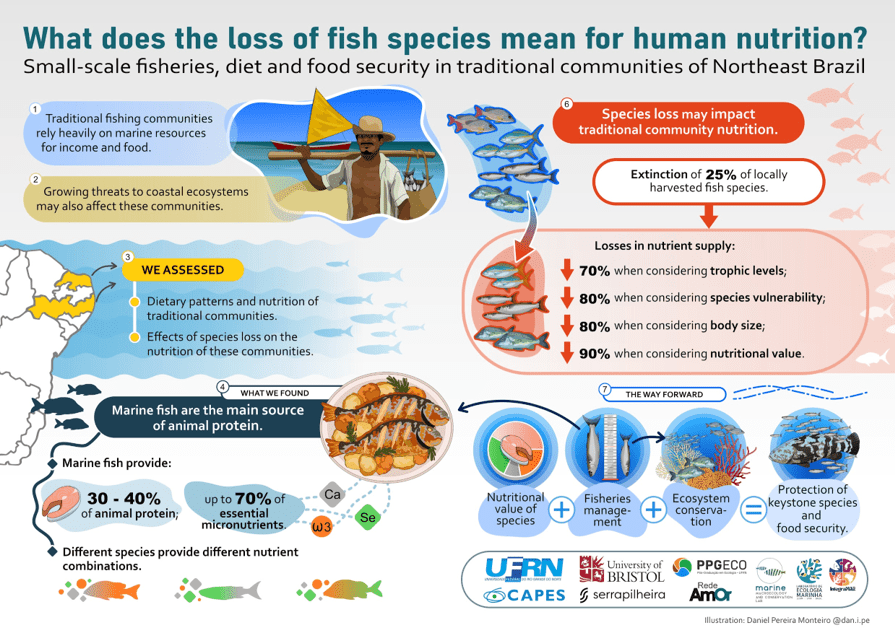
Fish are more than a source of food for traditional fishing communities in Northeast Brazil — they are central to livelihoods, culture, and health. This infographic summarizes the main findings of our study, which explored how marine biodiversity supports human nutrition and what may be lost when fish species decline.
By combining information on food consumption with the nutritional value of different fish species, we found that marine fish provide 30–40% of all animal protein consumed by fishing families. More importantly, fish diversity supplies most of the essential micronutrients in local diets, including calcium, selenium, and omega-3 fatty acids. Different fish species contribute different nutrient combinations, meaning that biodiversity plays a key role in maintaining healthy diets.
Using simulated scenarios of species loss, we show that losing just 25% of locally harvested fish species could reduce the availability of essential nutrients by more than 70%. In scenarios where nutritionally important species are lost, this reduction can exceed 90%. These results highlight that biodiversity loss does not only threaten ecosystems, but also increases the risk of malnutrition and poor health in communities that depend directly on the ocean.
The infographic also points to a way forward. By incorporating the nutritional value of species into fisheries management and conservation planning, it is possible to protect both marine ecosystems and human well-being. In this sense, conserving fish biodiversity is not only an environmental goal — it is also a strategy for food security and public health.
Portuguese translation | Infographic and infographic information
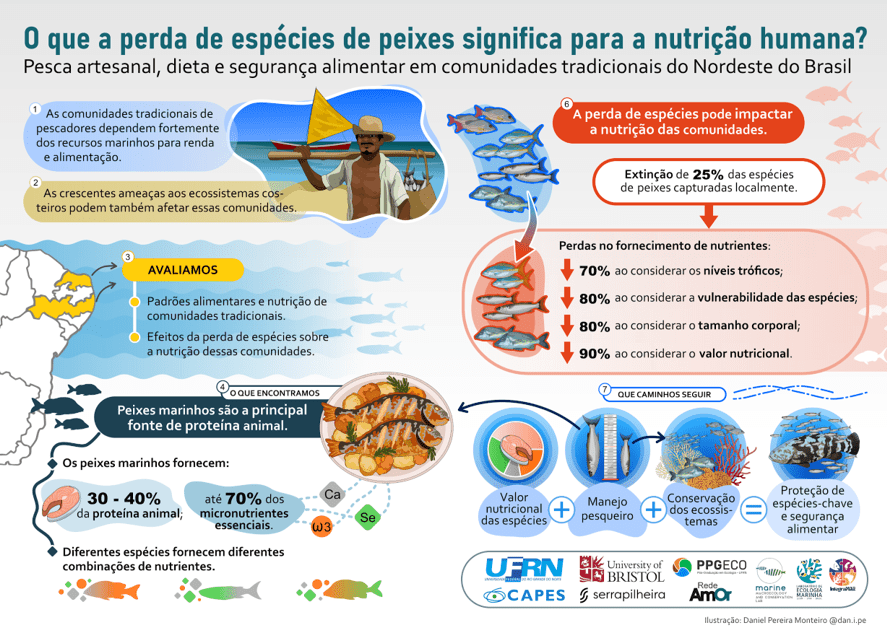
Para comunidades tradicionais de pescadores do Nordeste do Brasil, o peixe é muito mais do que alimento — ele sustenta os meios de vida, a cultura e a saúde. Este infográfico resume os principais resultados do nosso estudo, que investigou como a biodiversidade marinha contribui para a nutrição humana e o que pode ser perdido com o declínio das espécies de peixes.
Ao integrar dados sobre consumo alimentar com informações sobre o valor nutricional de diferentes espécies, mostramos que os peixes marinhos fornecem de 30% a 40% de toda a proteína de origem animal consumida pelas famílias pesqueiras. Mais do que isso, a diversidade de peixes é responsável pela maior parte dos micronutrientes essenciais da dieta local, como cálcio, selênio e ácidos graxos ômega-3. Cada espécie contribui com combinações diferentes de nutrientes, o que torna a biodiversidade fundamental para uma alimentação saudável.
Por meio de simulações de perda de espécies, demonstramos que a extinção de apenas 25% das espécies de peixes capturadas localmente pode reduzir a disponibilidade de nutrientes essenciais em mais de 70%. Em cenários em que as espécies mais nutritivas são perdidas, essa redução pode ultrapassar 90%. Esses resultados mostram que a perda de biodiversidade não ameaça apenas os ecossistemas, mas também aumenta o risco de má nutrição e problemas de saúde em comunidades que dependem diretamente do oceano.
O infográfico também aponta caminhos para o futuro. Ao incorporar o valor nutricional das espécies no manejo pesqueiro e no planejamento da conservação, é possível proteger simultaneamente os ecossistemas marinhos e o bem-estar humano. Nesse sentido, conservar a biodiversidade dos peixes não é apenas uma meta ambiental — é também uma estratégia de segurança alimentar e de saúde pública.
 Relational Thinking