By Bernd Lenzner, Andreas Baumann, Sietze Norder, Franz Essl, and Hannes A. Fellner
This Plain Language Summary is published in advance of the paper discussed. Please check back soon for a link to the full paper.
Human activities have long shaped both biological and cultural diversity. Currently around 1 million species are heading towards extinction and almost half the world’s languages are at risk of vanishing. Losing species means not only the loss of unique biodiversity but also vital ecosystem functions and human livelihoods. The loss of languages (which can be a proxy for cultural diversity) erodes cultural identities as well as indigenous and local knowledge.
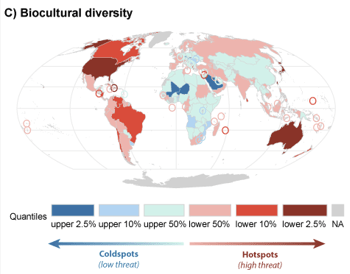
In this study we use global data on species diversity (amphibians, birds, mammals, and reptiles) and linguistic diversity, coupled with information on how threatened both are across the countries of the world, to pinpoint global hotspots where species and languages are particularly threatened. We then investigate whether contemporary factors like land conversion or historic factors associated with European colonialism explain the distribution of these hotspots.
The hotspots of language and species threats differ across the globe. Today, urbanization mainly threatens languages, especially in regions where many people live close together. On the other hand, humans changing ecosystems for agriculture especially threatens species biodiversity, particularly in highly developed regions. Despite these differences, a striking discovery is the lasting impact of European colonialism on language and species endangerment. Regions European powers once colonized tend to face the highest levels of threat to both biological and cultural diversity and this effect becomes stronger the longer a country was colonized.
The results of the study underscore the importance of understanding historical human impacts. Colonial legacies continue to shape both natural and cultural landscapes and influence the diversity patterns we see today. We can translate these finding into today’s time with its ongoing globalization where similar or even stronger large-scale interventions in cultural and environmental systems will likely also result in long-term consequences that are currently invisible.
 Relational Thinking