By Marie-Morgane Rouyer, Juliette Aminian Biquet, Isabelle Claire Parada Dela Paz, Axel Eriksson, Jay Marisca Gietzelt, Evgeniia Kostianaia, Paul Mukhin, Sean Russell, María Elisa Sánchez, Danian Singh, Deign Frolley Cabañero Soriano, Swetha Stotra Bhashyam, and Niklas Weins
This Plain Language Summary is published in advance of the paper discussed. Please check back soon for a link to the full paper.
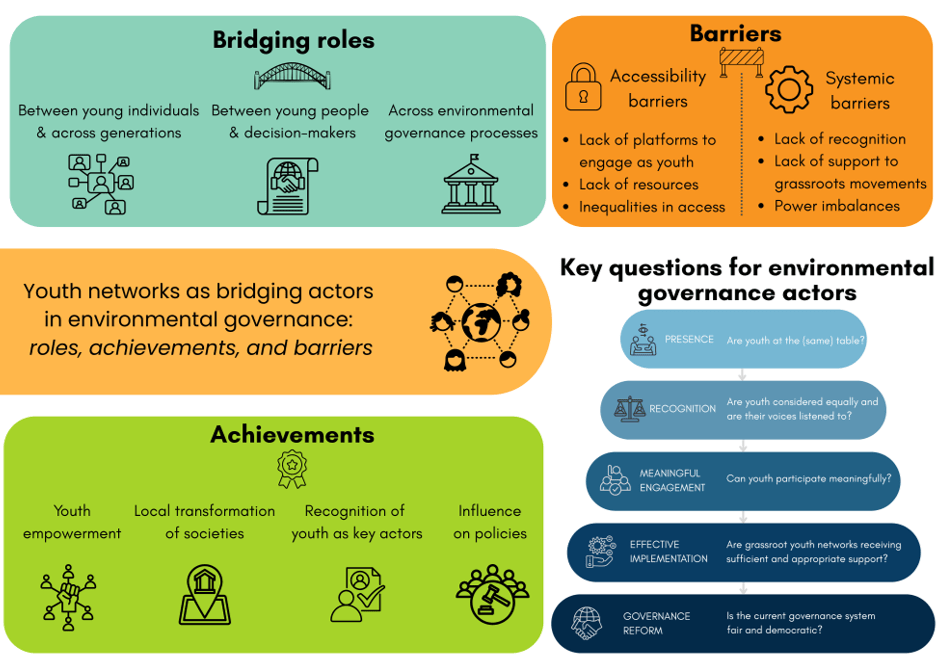
Youth networks are driving positive, bottom-up changes for people and nature and play important bridging roles in environmental governance, contributing to the democratisation of decision-making. Yet, their participation is not yet mainstreamed nor meaningful.
Addressing the current socio-environmental crises requires important societal changes, including in the way decisions are taken. Actors that are often marginalised in decision-making, such as young people, should be able to participate meaningfully. Despite being a major demographic group, young people are poorly represented in decision-making, as they are often not considered as political actors. To overcome this lack of participation, young people have created alternative pathways of participation, such as youth networks. These networks unite young individuals and organisations, acting together to contribute to solving societal issues and move towards a desired future for themselves and future generations. Yet, their roles in environmental governance have been poorly studied and previous research has argued that we need to adopt a youth-centred perspective to understand their contributions and achievements better.
In this study, we bring together experiences acquired by 12 youth networks engaged in environmental governance at the local, national and international levels, on diverse issues such as biodiversity, ocean, forest, and climate. We shed light on the bridging roles that youth networks play in environmental governance, identify some of their achievements and barriers, and offer recommendations to strengthen their meaningful participation.
We show that youth networks connect young individuals and generations, foster interactions between grassroots movements and decision-makers, and between environmental governance processes. Their engagement are often rooted in shared values and relationships, such as care for nature.
We also show that youth networks have accomplished tangible achievements: they empower youth to transform parts of societies, are pivotal for the recognition of youth as key actors, and influence some policy processes.
Yet, they face major barriers that hinder their meaningful engagement and contributions. Accessibility barriers include lack of dedicated platforms to engage as youth in environmental governance, lack of resources, especially funding, and large inequalities in accessing environmental governance. Systemic barriers include lack of recognition, as young people are often not considered equally with other actors, lack of support to grassroots youth groups driving societal and cultural shifts on the ground, and large power imbalances in environmental governance.
We recommend that environmental governance actors pay more attention to the processes of youth participation, recognise youth rights to participate in decision-making, follow existing best practices on meaningful youth engagement, better support grassroots communities and projects, and critically rethink environmental governance to prevent power imbalances.
All environmental governance actors and generations need to work together to overcome youth engagement barriers and ensure the meaningful participation of this key but overlooked demographic group, that is crucial for the needed societal transformations ahead of us
 Relational Thinking