In celebration of the shortlisted papers for the Rachel Carson Prize 2025 for Early Career Researchers, we’re delighted to introduce you to some of our shortlisted individuals and papers.
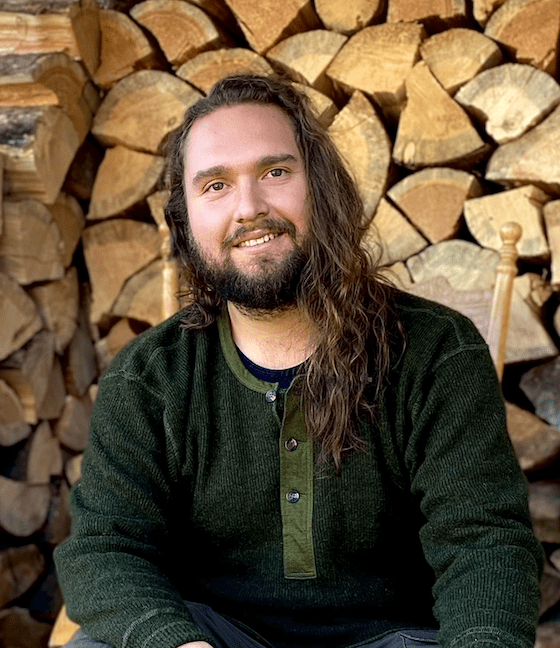
SPENCER GREENING (He/him)
Read Spencer’s shortlisted paper: ‘Gugwilx’ya’ansk and goats: Indigenous perspectives on governance, stewardship and relationality in mountain goat (mati) hunting in Gitga’at territory‘.
About the paper:
What is your shortlisted paper about, and what are you seeking to answer with your research?
In essence, my paper is about the actionable ways humans can understand themselves as a part of ecosystems through harvesting. Specifically, it looks at one example: the Indigenous knowledge of the Tsimshian people of the Pacific Northwest Coast of Canada, of which I belong to, and how my journey of being groomed into a mountain goat ( mati, oreamnos americanus) harvester is emblematic of our relationship with many species in our territory. By highlighting this process, one can really see how embedded ecological pedagogy is within Indigenous harvesting practices.
Were you surprised by anything when working on it? Did you have any challenges to overcome?
Because this work consisted of experiential learning over decades, there were no immediate surprises. However, the work brought several life epiphanies and lessons, ranging from the broad to more personal. Perhaps one of the loudest lessons was how it takes years, sometimes generations, to see your influence in an ecosystem, and that; (1) missteps with ecosystems can be unnoticed over long periods of time until they sneak up on you, and (2) how you may not see the ideal results in this lifetime. One of the biggest challenges was moving through my own unrealistic expectations for ‘results’, which lead to unnecessary feelings of powerlessness. In contrast, we must be at peace in these situations and understand that these deep-time processes are about ongoing in-situ relationships, and the progress resulting from that.
What is the next step in this field going to be?
The next step for me is to continue to live as a steward towards this species and their ecosystem, while passing down these teachings to my new daughter, and her generation. It will be my lifelong goal to ensure that the responsibilities around mountain goat stewardship (and all species we harvest) are remembered and practiced by my people indefinitely.
What are the broader impacts or implications of your research for policy or practice?
My goal while writing this paper was to tell a digestible story of how we, Indigenous people, understand ourselves as a part of our own ecosystem, while being both completely dependent upon said ecosystem, and sensitive to it. My hope is that through storytelling and readers’ own imaginations and problem solving, they can apply these teachings to themselves in their own backyards. This allows the broader impacts to shine, that being, us seeing ourselves as an inherent part of the ecosystems we inhabit, while being more introspective and accountable to the non-human world around us.
Ideally, practicing these lived values and relationships can lead to social systems grounded in stronger ecological ethics.
About the author:
How did you get involved in ecology?
I got involved in Ecology through harvesting with my tribal elders, which in turn, helped me understand the importance of the role of harvester and steward in our traditional governance system.
What is your current position?
I am currently a postdoctoral fellow at the University of Victoria, where I am working on a book manuscript that dives deeper into the Indigenous laws, spirituality, and ethics of harvesting by my people, and how these stories can positively influence modern relationships and management of wildlife. In addition to this, I am always working closely with my community on governance, research, and passing knowledge down to next generations.
What one piece of advice would you give to someone in your field?
When it comes to ecological work, it is easy to lose hope in a space that seems to continuously be in crisis. However, remember that with a sense of purpose, hope, and good storytelling, we can amplify the tangible ways humans benefit ecosystems. There are countless stories where humans make natural places more bountiful and biodiverse, and the world needs to know that we humans aren’t inherently harmful to the earth, we just need be in better relationship with it.
Read Spencer’s shortlisted paper: ‘Gugwilx’ya’ansk and goats: Indigenous perspectives on governance, stewardship and relationality in mountain goat (mati) hunting in Gitga’at territory‘.
 Relational Thinking