By Elliot Convery-Fisher, Adam Devenish, Sam Staddon, Christian Kull, F. Laura Rafanomezantsoa, and Tianjanahary Randriamboavonjy, and Caroline E. R. Lehmann
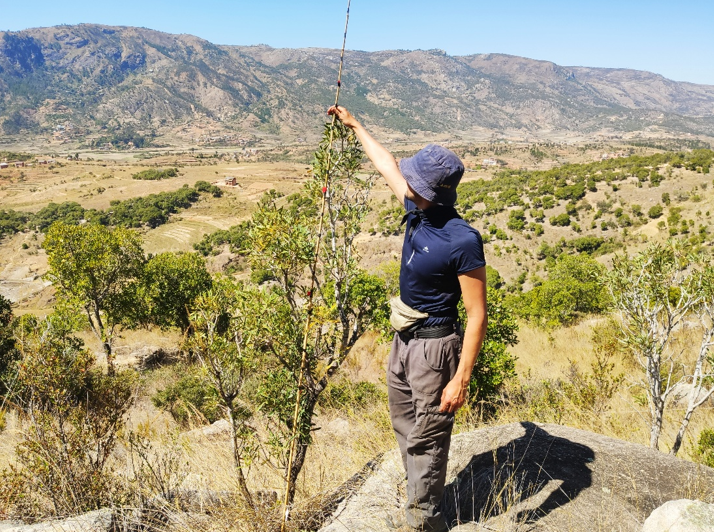
The stories told about Madagascar’s Central Highlands usually paint a picture of rapid deforestation and native habitat loss. However, our 73-year study reveals that native woodlands, known as tapia woodlands because of the dominance of the tapia tree, have remained remarkably stable in their overall structure for decades.
We tracked changes in these woodlands from 1949 to the present day using historical aerial photos and modern satellite imagery. We also spent time listening to local community members, who provided their lived history of the landscape. What we found challenges the usual story that humans cause deforestation. Even near busy roads and growing villages, the core structure of tapia woodlands has held firm. This suggests that traditional land-use practices likely assist the ecosystem to stay resilient, rather than causing its downfall.
Nonetheless, we did demonstrate changes. While the forest looks stable from a distance, the variety of trees inside is changing. Local people explained that while they protect the woodland, they selectively harvest certain hardy native trees to build homes, carts, and planks. Because these specific trees are valuable, they are disappearing even while the rest of the forest remains standing. This shows how a forest can look healthy in a satellite image while still losing its unique diversity under the tree canopy and highlights the value of using local lived experience to monitor ecosystem change.
Our study shifts the focus away from blaming rural communities for deforestation. Instead, it highlights that local management may be one of the reasons these woodlands still exist. The real emerging threat we detected is the rapid spread of non-native tree species, like pines, which have expanded rapidly in this landscape, including into the woodlands themselves. Moving forward, conservation policies should support local people to manage the spread of non-native trees, and restore woodland diversity, ensuring that the full spectrum of Madagascar’s unique biodiversity is protected for the next generation.
 Relational Thinking