In celebration of the shortlisted papers for the Rachel Carson Prize 2025 for Early Career Researchers, we’re delighted to introduce you to some of our shortlisted individuals and papers.
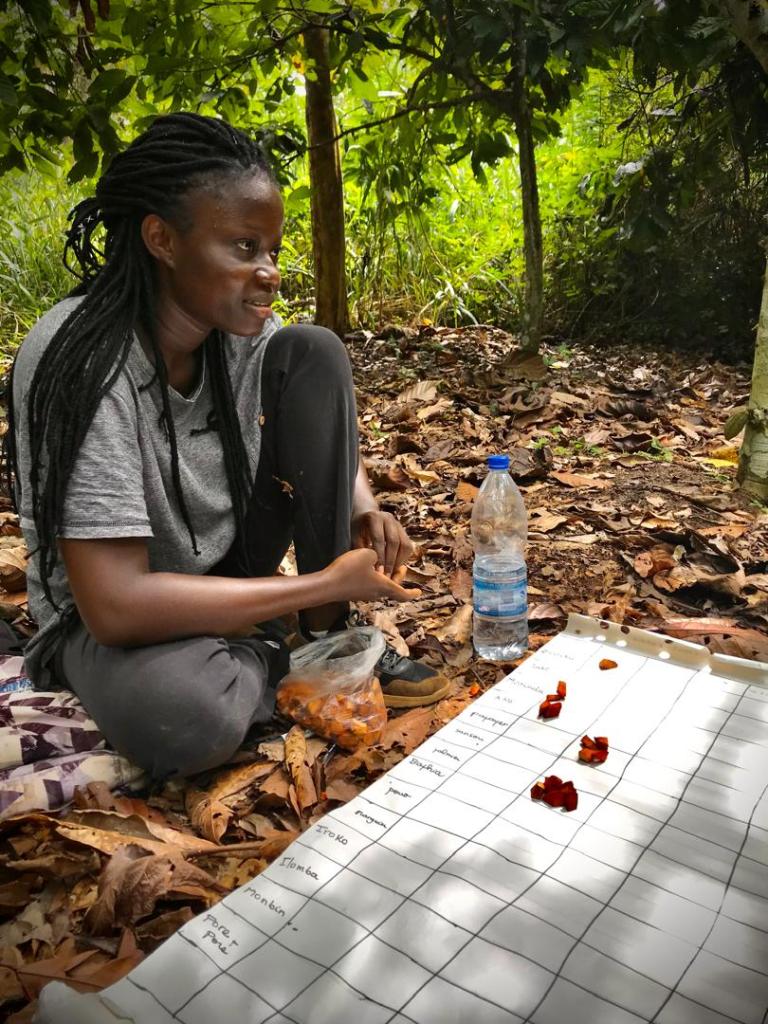
Photographer credits – Picture 1: Bruno Hérault, Ecologist at Forest and Societies Unit of Cirad.
Marie Ruth Dago (She/her)
Read Marie’s shortlisted paper: ‘What motivates West African cocoa farmers to value trees? Taking the 4 W approach to the heart of the field‘.
About the paper:
What is your shortlisted paper about, and what are you seeking to answer with your research?
Our shortlisted paper was focused on the reasons that encourage cocoa farmers in Côte d’Ivoire in West Africa to add value to trees in their cocoa farms. It examines how and why cocoa farmers conserve trees and uptake agroforestry in deforestation and climate change context. Our research seeks to list trees uses and answer how social, historical, geographical and ecological factors influence farmer’s motivations to retain certain trees species in cocoa farms.
Were you surprised by anything when working on it? Did you have any challenges to overcome?
Specially, during the data collection phase, we were pleasantly surprised for the richness traditional knowledge among farmers and their household members. During interviews, we were able to build a large database on the uses of trees in agroforestry systems. I was also surprised by the diversity of criteria farmers use when deciding which trees to conserve. For example, regarding tree uses, we expected food, traditional medicine, and economic value to be the main categories for which trees were highly valued, but social considerations also were also very important for them.
What is the next step in this field going to be?
The next step in this field is to identify the farms where low levels of tree valorization have been observed and to promote strategies that can strengthen farmers’ motivation to conserve trees, to maximize the conservation of forest species. Another important perspective would be to conduct an in-depth analysis of farmers’ economic dependence on the commercialization of agroforestry tree products.
What are the broader impacts or implications of your research for policy or practice?
This study was able to provide a tool through which concrete actions can be taken. The 4 W (Who, What, Where and When) offer four dimensions that represent key areas through which we can intervene and ensure better adoption of agroforestry practices.
About the author:
How did you get involved in ecology?
Initially, I trained as an agronomist, but during my education, I became very interested in intraspecific diversity and interaction in forest stands, as well as the modelling of these forest dynamics.
What is your current position?
I completed my PhD in Environmental sciences in Côte d’Ivoire four months ago. I am currently at post-doctoral position at CIRAD. My research focuses on understanding how cocoa farmers diversify their sources of income and on assessing the socio-economic and ecological impacts of adopting agroforestry practices. In the future, I would also like to be able to conduct studies in forest landscapes other than those in West Africa, for example by exploring forest dynamics in Central Africa or East Africa, or even in the Amazon.
Have you continued the research your paper is about?
Absolutely, I am continuing the research my paper is about. The next article on strategies for increasing the value of trees may be submitted for review in the coming months.
What one piece of advice would you give to someone in your field?
I would advise researchers to adopt interdisciplinary approaches in ecology and to systematically integrate co-design methods with local communities.
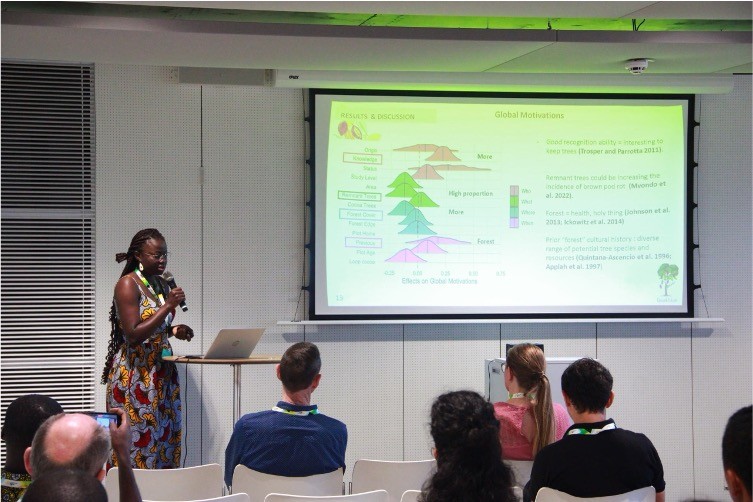
Photographer credits – Picture 2: Stephane Guei, PhD student at CCBAD, Côte d’Ivoire
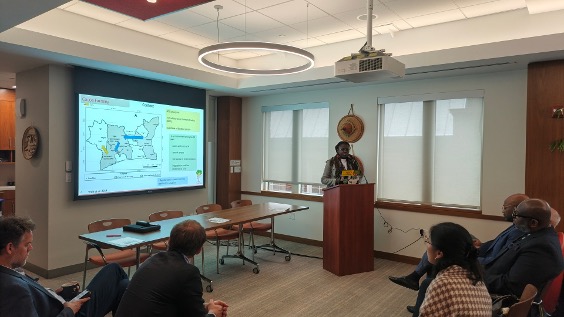
Photographer credits – Picture 3: Dr Jean-Luc Kouassi, Research professor
Read Marie’s shortlisted paper: ‘What motivates West African cocoa farmers to value trees? Taking the 4 W approach to the heart of the field‘.
 Relational Thinking