By Hyeonjeong Kim, Hanvit Lee, Laura Pereira and HyeJin Kim
Global environmental challenges – biodiversity loss, pollution, and climate change – are deeply intertwined with societal and political tensions. Yet ecological research and policy rarely reflect the voices of people living in conflict-affected or politically divided regions. As conflicts grow more frequent and environmental destruction widespread, alternative visions for just future are urgently needed.
This study focuses on the Demilitarised Zone (DMZ) of Korea, one of the world’s most politically sensitive regions. Through the DMZ Open Festival’s EcoPeace Forum, the government of Gyeonggi Province convened Korean citizens to co-create new visions for the area. Through a participatory visioning process drawing on global science and policy frameworks, interactive dialogues, and creative facilitation methods, participants imagined preferable and peaceful futures for people and nature on the Korean peninsula.
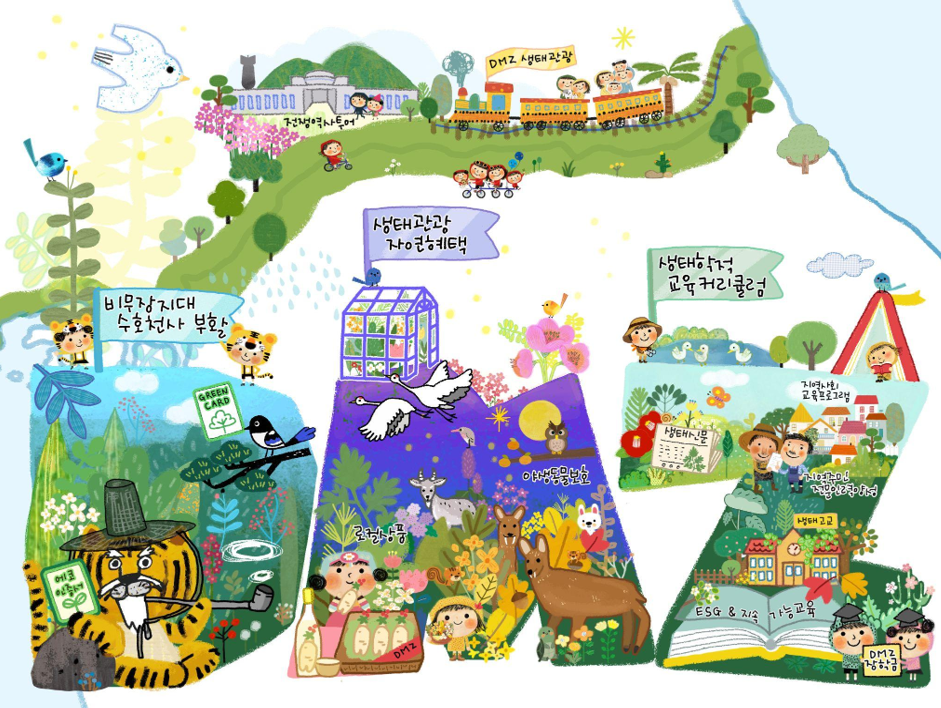
Participants’ visions emphasised human-nature coexistence with diverse forms of ecosystem restoration and rewilding, self-sustaining villages and communal living with improved social cohesion and wellbeing, convergence of tradition, culture and innovation, renewable energy transition, transformation in the economy, participatory governance and lifelong learning. Many viewed peace as an essential prerequisite for both nature recovery and human livelihood.
This study shows how the Korean Peninsula’s unique geopolitical context shapes how people imagine and negotiate future possibilities. Participatory visioning can be an effective method for incorporating citizens’ voices into decision spaces across jurisdictional levels. The science-policy-society interfaces can play a key role in connecting local aspirations to national and global goals. The co-developed visions presented in this study demonstrate the potential engage citizens in participatory governance for national planning, even within complex and divided contexts.
 Relational Thinking