By Megan Mucioki, Michelle Baumflek, Suzanne Greenlaw, Helen Aderman, Kathy McCovey, Frank K. Lake, Davin Holen, Jennifer Sowerwine, Daniel Sarna-Wojcicki, and Bronwen Powell.
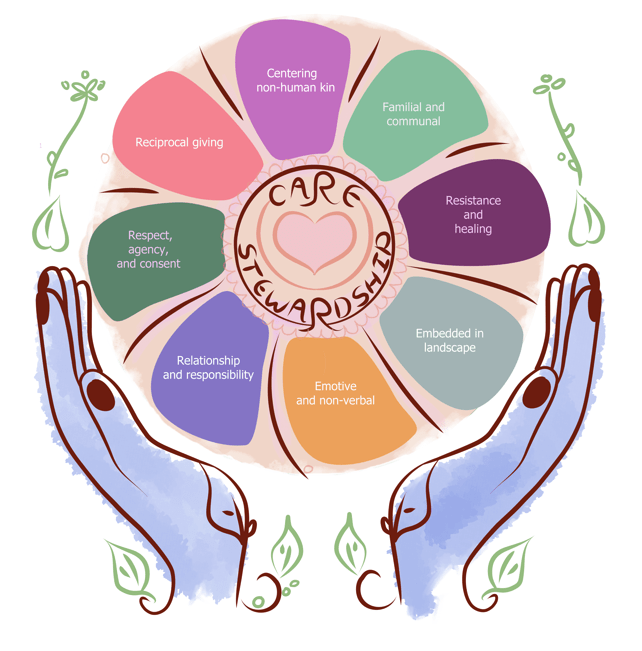
Indigenous environmental stewardship encompasses actions, traditions, practices, and relationships that Indigenous People carry out with land, environment, component species, and each other. It is based on responsibility to care for all kin and relational values connecting living and nonliving things. Indigenous environmental stewardship can shape what ecosystems look like, how they function, and the diversity and health of species found on the land. Care is an aspect of Indigenous environmental stewardship that often is a motivating factor and component of responsibility and relationship for Indigenous People. Our work examines how the concept and practice of care is integral to Indigenous environmental stewardship.
To meet this objective, we learned from cultural, plant-rich ecosystems and plant stewards in Indigenous communities in Southwest Alaska, Northern California, and Coastal Maine. Authors include six people of Euro-American descent, one Karuk Tribal member, one Karuk descendant, one Maliseet citizen, and one Yup’ik person. Groupings of authors engaged in three plant-focused projects that contributed to the ideas presented in this paper. An integration of qualitative data analysis, lived experience, and author discussion informed our findings.
We present and illustrate a concept of care, integral to Indigenous environmental stewardship, which includes eight components: responsibility and relationship, reciprocal giving for the future, family and community connections, respect agency and consent, centering non-human kin, resistance and healing, and care embedded in the landscape. We further illustrate in the paper and demonstrate how Indigenous plant stewards live these components of care in relationship to plants and environment.
Aligning care with stewardship requires reciprocity, relationship, and responsibility together, something that stewardship alone does not require. Care-centered stewardship challenges Western paradigms of environmental management to require ethics, values, and relationships as part of the process. It also pushes for Indigenous leadership in environmental stewardship. We hope our work will guide people in their responsibility to care, with recognition that responsibilities and actions look different depending on Tribal affiliation (or not) and institutional and professional roles. Through meaningful individual and collective action, care thus becomes essential—not as an addition to stewardship, but as its foundation.
 Relational Thinking