By Yiluan Song, Mallory Barnes, K. Ann Bybee-Finley, Kyla M. Dahlin, Travis McDevitt-Galles, Stephan B. Munch, Guillermo E. Ponce-Campos, Casey Youngflesh, Benjamin Zuckerberg, and Kai Zhu
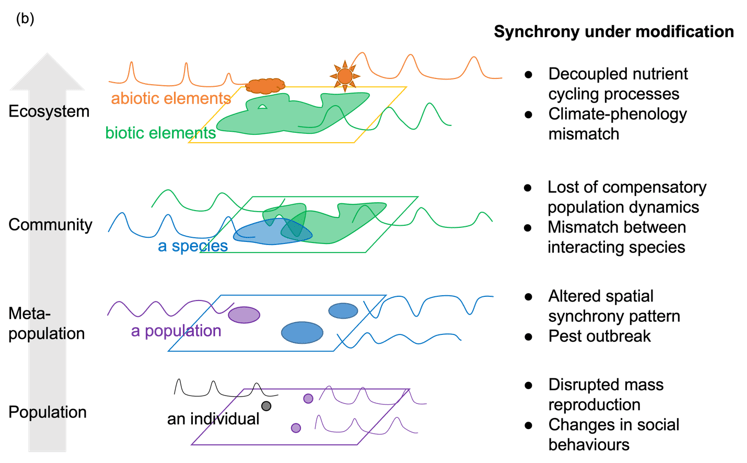
In nature, many events are delicately timed. Flowers bloom, insects emerge, predator and prey populations rise and fall, and rivers carry nutrients across landscapes, often in step with one another. Scientists call this ecological synchrony, when natural processes take place in coordinated rhythms.
Synchrony is vital for healthy ecosystems. It helps species survive, stabilizes communities, and sustains key processes like carbon and nutrient cycling. When synchrony breaks down, ecosystems can become less predictable. This not only affects plants and animals but also the benefits on which people rely, such as food production, clean water, and disease regulation.
Much of the research on synchrony has focused on climate change, but the role of human activities is often missing from the discussion. We reviewed evidence from existing studies on how farming, harvesting, urbanization, and other human actions reshape ecological synchrony. Leveraging big data, we also demonstrated the possible role of human activities through four case studies from croplands, bird communities, marine fisheries, and mosquito populations.
We found that human activities often unintentionally disrupt synchrony. In systems where high synchrony is needed, such as the transportation of reacting chemicals in streamflows, human disturbance can make processes less synchronized, degrading water quality. Conversely, in systems that benefit from asynchrony, such as communities where species rise and fall in their abundance differently, human actions can make them too synchronized. For instance, intensive farming and urban development often cause species to fluctuate in unison, which reduces the stability of biodiversity and increases risks like pest outbreaks.
Humans can also actively manage synchrony. Adaptive practices, such as adjusting crop sowing dates, synchronize the life cycle of crops with the rise of temperature, taking advantage of the warming climate to improve yields. Nevertheless, management with synchrony as an explicit goal is still rare. To move forward, we suggest a set of guiding questions to help managers and stakeholders discuss what kind of ecological synchrony we hope to achieve and anticipate the effects of management. By making synchrony a clear target in sustainability planning, we can better safeguard both ecosystems and human well-being.
 Relational Thinking