By Sheena Carlisle, Susan Baker, Euan Bowditch, Natasha Constant, Tom Finch, Melissa Minter, Alix Syder.
This Plain Language Summary is published in advance of the paper discussed. Please check back soon for a link to the full paper.
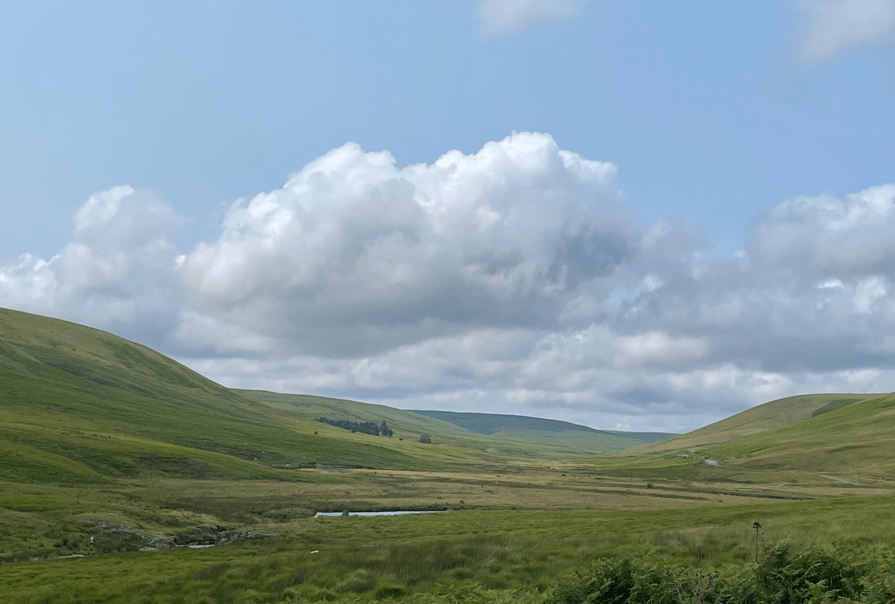
The research aims to identify and analyse layers of hidden historical and emotional connections to place which can threaten local support for landscape change. This can impact local stakeholder responses to future tree planting which support the journey to net-zero. This provides an important addition to environmental & economic criteria for landscape reforms. We argue for the importance of listening to local voices who live and work in a landscape. A study of the Elenydd, an upland landscape in Mid Wales, UK, uses data derived from semi-structured interviews and workshops to evaluate how people’s close connection to place is linked to two significant historical events in the landscape including the construction of reservoirs in the early 1900s and planting conifer tree plantations in the 1930-1980s. Both events led to the appropriation and sale of land and village and farm clearances. The results reveal how people currently living and working in an upland environment have an inherent connection to place as well as its history and culture. This increases the need for local stakeholders to be heard with an appreciation and recognition of historical and cultural contexts. Emotional connection and care of a landscape can help support increase tree planting in upland environments. This work can also be used in different landscape change situations, regions and countries to help stakeholder engagement processes and treescape expansion management that honestly consider histories that connect with people’s place attachment and include local knowledge and experiences. The findings of this study are also relevant to other rural landscapes where there is a need to increase tree planting and create landscape change.
 Relational Thinking