By Louise Sing, Marc J. Metzger, Stephen Bathgate, Christina Tracey, and Duncan Ray
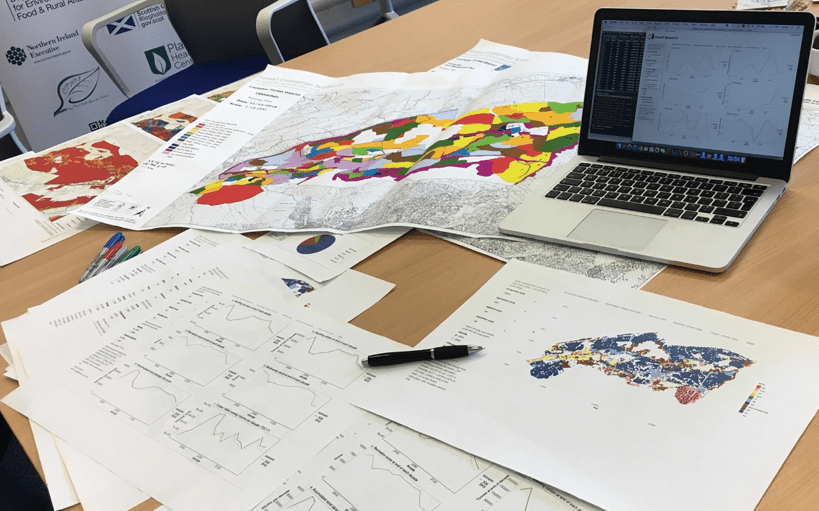
Photo credit: Louise Sing.
Forest managers and planners are under growing pressure to manage forests not just for timber, but also for other public benefits like biodiversity, recreation, carbon storage, and climate resilience. However, traditional forestry methods often focus only on timber production and do not account for these wider benefits. This study explores how scenario planning — a technique for imagining and preparing for different possible futures — can help forest managers make better decisions.
The research took place over six years in Leanachan Forest, located in northwest Scotland. This forest is important not only for timber but also for biodiversity, tourism, and recreation. Researchers worked closely with the forest planning manager to test how maps and computer models showing ecosystem services such as carbon storage, wildlife habitat, and recreational value could support long-term planning decisions.
The process involved a deep collaboration between scientists and practitioners, known as ‘co-production’. They worked through six phases: understanding the planning problem, collecting data, creating baseline maps of services, modelling future scenarios, interpreting results, and reflecting on lessons learned. Throughout, the forest planning manager was actively involved, helping to shape and apply the research in real-world planning.
The project tested six future scenarios with different combinations of tree species and management methods. These included traditional approaches, more nature-focused planting, and species better suited to a changing climate. The outcomes showed how certain tree species choices, suited to the varied site types of Leanachan Forest, could improve both biodiversity and recreational experiences, without significantly harming timber output.
From the experience, seven key lessons emerged:
- Scenarios can reveal new planting and management options that support non-timber benefits like wildlife and recreation, while still maintaining timber yields.
- Scenario tools help managers understand trade-offs between different forest goals — such as how choosing one tree species may benefit carbon storage but limit biodiversity.
- Visualisation tools are essential. The forest manager found maps and interactive tools helpful to explore how decisions might play out over decades.
- Data limitations are a real barrier. Some important services, like water quality or detailed biodiversity measures, couldn’t be fully included due to lack of local data.
- Knowledge gaps about climate impacts on tree species make it difficult to confidently plan for the long term.
- Time and stakeholder involvement are crucial. The forest manager wished for more time to test scenarios and involve colleagues in planning discussions.
- Long-term collaboration is essential. The success of this project came from years of regular engagement and mutual learning between researchers and practitioners.
In conclusion, this study shows that scenario planning, when done collaboratively, can be a powerful tool for forest managers. It helps them consider a wide range of benefits and risks, making better-informed decisions for an uncertain future under climate change. For such a process to work, it requires the right tools, data, time, and commitment from all sides.
 Relational Thinking