By Gunnar Dressler, Lance Robinson, and Birgit Müller
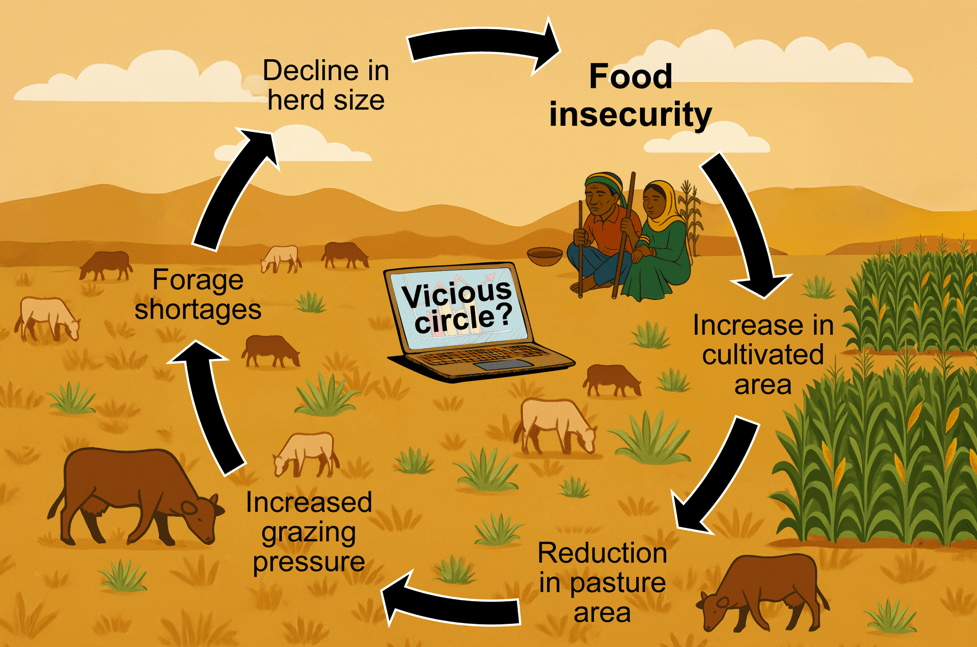
How the expansion of crop farming impacts the traditional livelihoods of people who rely on raising livestock (pastoralists), is a critical issue in dryland regions like southern Ethiopia. We discovered that while adopting cultivation offers immediate relief for many smallholder households facing food insecurity, it can also trap the most vulnerable in a deeper cycle of hardship, ultimately increasing overall inequality.
Traditionally, communities in these dry areas depend on livestock herding, but climate change and reduced mobility are pushing them towards farming. We developed a computer simulation model, called LUCID, to understand these complex dynamics over the long term, specifically focusing on the Borana Zone in Ethiopia. The model simulates how individual households manage their herds and decide to cultivate land, particularly when they become food insecure.
Our simulations showed a complex picture. On the one hand, allowing households to grow crops reduces the overall number of households experiencing food insecurity. However, this is a short-term benefit for many, and for those households who remain food insecure, the situation worsens significantly. Households that do not increase their food security after cultivating land experience much lower levels of food security and greater consumption deficits compared to when they relied solely on livestock. This creates greater inequality in food security across the community. Our findings indicate that this can indeed set in motion a “vicious circle” where reduced pasture area, declining herds, and continued farming reinforce each other. This negative feedback loop is more likely in drier climates or when herd productivity (how well livestock produce) is low.
We believe that coexistence between pastoralism and crop farming is possible, especially if the amount of cultivated land per household is kept moderate. However, uncontrolled expansion without proper management could undermine long-term well-being and resilience (the ability to recover from shocks). Our work suggests that policies focusing on strategic land use planning and strengthening communal land rights are vital to protect essential grazing areas and ensure that farming genuinely benefits those most in need, rather than worsening their plight. While our model simplifies some aspects, it provides crucial insights into these interlocking challenges.
 Relational Thinking