By Emily Zepeda, Elizabeth Elliot Noe, Christopher J. Schell, and Andrew Sih
As coyote populations grow in North American cities, human-coyote interactions are becoming more frequent. Understanding what factors shape these interactions and how humans perceive coyotes is critical for facilitating human-coyote coexistence in cities.
Research shows that access to nature, direct interactions with wildlife and cultural factors can influence how people think about and feel toward wildlife. A person’s sociodemographic characteristics like socioeconomic class, race, gender, and education partially shape cultural factors because a person’s identity within these characteristics shapes their exposure to wildlife directly and indirectly. Direct experiences with nature tend to happen more frequently for people with higher incomes, White people, men, and those with more education because they have more time, money, and more social permission to engage in outdoor activities. Indirectly, sociodemographic characteristics shape the type of stories, media, and other cultural processes that shape how people relate to wildlife.
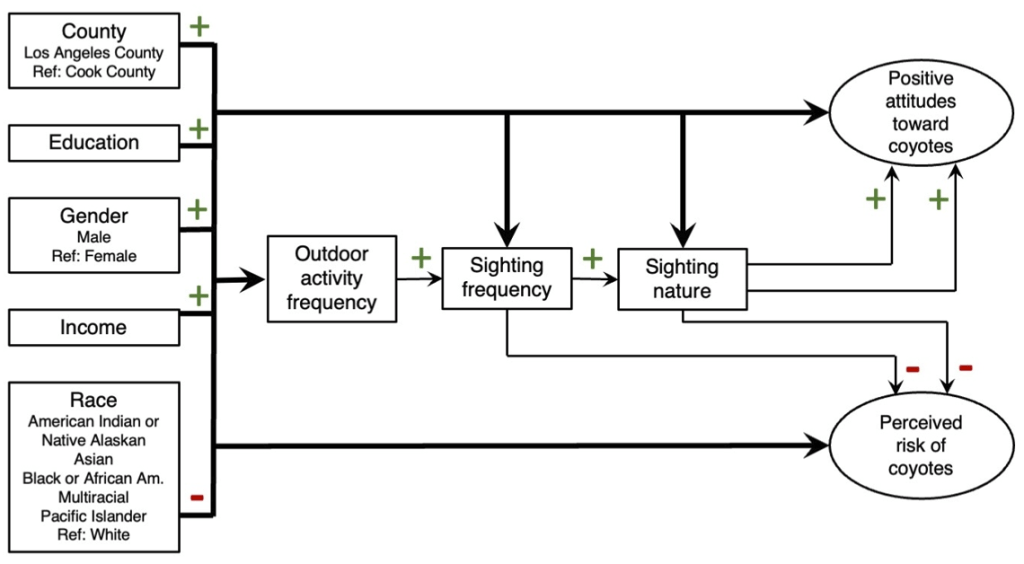
To understand how sociodemographic characteristics are related to a person’s experience with and attitudes toward coyotes, we used data from a survey distributed to people living in Los Angeles County, California and Cook County, Illinois. We found that women, participants who identified as Asian, Pacific Islander, or Black, and participants with low incomes tended to have less positive attitudes and greater fear toward coyotes than men, participants who identified as White, and participants with high incomes.
For some groups, these differences were partly explained by varying levels of experience with nature and coyotes. Asian and Pacific islander participants and participants with low income reported spending less time outdoors than White and high-income participants. Asian and Pacific Islander participants, participants with low incomes and women also reported seeing coyotes less often than White participants, high-income participants, and men. Because direct experience with nature and wildlife can shape how people feel about wildlife, differences in outdoor activity and sightings may help explain why some groups feel more wary of coyotes than others.
Our findings demonstrate that different sociodemographic groups tend to have different relationships with coyotes and that this depends, in part, on a person’s direct experiences with the animals. This adds to the growing research on human-wildlife interactions showing that efforts to manage these interactions have to evaluate the needs of different groups of human to design effective and just management interventions.
 Relational Thinking