By Yael Lehnardt, Gopal Murali, Uri Roll, and Oded Berger-Tal
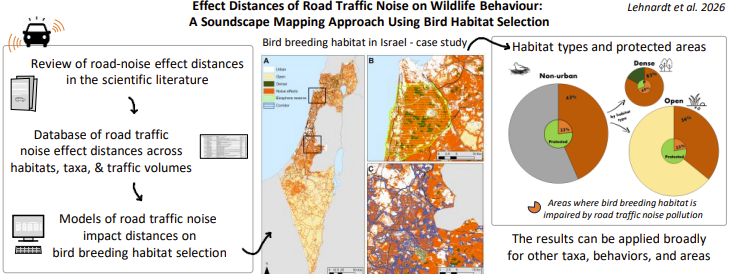
Road traffic noise reaches much farther into natural areas than most people realise. Exposure to noise pollution can disrupt many key animal behaviours, including finding food, avoiding predators, caring for young, and communicating with one another. While people can measure, model, and map noise, these measurements do not directly tell us if and how noise affects animals.
In our study, we initially constructed a new database that we derived from previously published scientific literature, encompassing the various impacts of road traffic noise on wildlife behaviours and the distances at which these effects were observed. We found a long list of species and behaviours that road noise affects – up to several kilometres away. Following this, we evaluated the potential ‘area cost’ of road noise for an entire country – meaning how much land is lost as potential habitat just due to behavioral response to noise. To calculate this area loss, we used a ‘soundscape mapping’ approach. It was originally developed in acoustics and engineering to highlight the impacts that sounds have on people’s perception, depicting the rating value of the environment rather than noise measurements. Here, we adapted this approach to wildlife to create the first wildlife-oriented soundscape map. We concentrated on the behavior and species scientists most frequently study, specifically, the habitat choices birds make about where to live and raise their young.
When we analyzed the potential loss of area due to the effects of road traffic noise on breeding birds’ habitat selection over the entire country of Israel, we found an alarming trend: hazardous noise pollution may negatively affect 42% of Israel’s non-urban areas, and alarmingly, 23% of the protected areas.
Overall, our findings highlight the damaging effects of road traffic noise on wild animals, and the area-costs it carries. Future applications can help us, humans, understand how animals experience the world and reveal places where noise causes hidden pressure. Our work can both advance our knowledge and understanding of this topic and promote policy that will target invisible pollution, such as noise.
 Relational Thinking