By Solène Guenat and Leonie K. Fischer
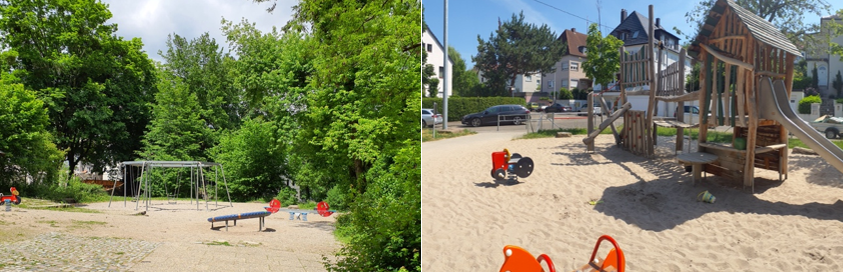
Playgrounds are where children have most of their daily interactions with nature. But what plants do children find in playgrounds? And do those plants influence how preschool children feel, and how they interact with nature? Those are questions we are trying to answer with our research, especially as we know from a lot of previous research on adults that interactions with nature can improve wellbeing.
We counted the different species of plants in 47 playgrounds of Stuttgart, Germany differentiating between trees, shrubs and flowers, and grasses. In those same playgrounds, we distributed questions to parents, asking them about the emotions of their children in the last two weeks as well as whether and how they played with natural elements (for example, sticks, rocks, leaves, flowers, insects). The questionnaires were distributed throughout the year, so that we had answers for each season.
We found that young children’s wellbeing was higher when there was a large diversity of trees in the playground. Children who felt close to nature, or interacted a lot with natural elements, also had a higher wellbeing than the others. The season influenced both the wellbeing of the children and how they related with nature, with stronger levels of nature interactions in summer but better wellbeing in winter.
This study shows how playgrounds can be designed to improve the wellbeing of young children: by increasing the diversity of trees, and by trying to increase interactions with nature, maybe by having spaces with wilder nature within traditional playgrounds.
 Relational Thinking